


Thanks to our Presenting Sponsors Hire Education, Tuck Advisors, and Cooley, for making Edtech Insiders possible.


There’s More to AI Grading Than Scoring
Sponsored by Overdeck Family Foundation
By: Lin Ler
Lin Ler is a Stanford MBA and MA in Education candidate working at the intersection of business strategy, learning science, and frontier AI. With a background spanning management consulting, EdTech startups, and the social sector, Lin translates complex AI capabilities into practical insight for the future of learning.
Special thanks to Overdeck Family Foundation for sponsoring this article, the third of seven in our AI & Efficacy Editorial Research Series diving into key research findings from Stanford’s AI Hub for Education Research Repository (a project by Stanford’s SCALE Initiative). Stay tuned for more!
When gauging the value of an AI grading tool, typically there is an appeal to scoring accuracy: the AI scores student work as reliably as a trained human grader. That claim, in many cases, is true. But, it’s not showing the whole picture.
In a pre-registered randomized trial across 178 public schools in Brazil, roughly 19,000 students preparing for the national university entrance exam were split into two groups: one had AI score their essays, the other had AI an scorer plus human graders reviewing every essay. Both groups of students improved their scores by about a tenth of a standard deviation. For structured scoring against a clear rubric, AI performs at the level of a trained human reviewer.
However, feedback on student work is different from scoring, and it’s generally lumped into the tasks a “grading” tool will complete. Feedback requires identifying what a specific student got wrong in the context of that student’s specific reasoning, and explaining what to do differently. This is a diagnostic act.
When a school adopts an “AI grading” tool, it’s generally implemented to support both of these tasks: scoring and feedback. But, most evaluations for AI grading tools only measure the effectiveness of the first task. And, these tasks are often performed most effectively by different LLMs. A 2024 study testing three AI systems on middle-school math open-ended responses found that the model that scored most reliably produced feedback teachers chose only 12% of the time. The model whose feedback teachers trusted most — GPT-4 — turned out to be the worst scorer of the three models tested. The model teachers wanted to use for explaining errors to students was not the model that scored accurately. They were optimized for different things.
This lumping together of scoring and feedback into the broad category of “grading” opens up risk for incorrect information and ineffective results. Let’s dive into it.
When AI Grading Works Best: Scoring and Feed Forward Feedback
Before examining where AI grading fails, let’s be precise about where it is working.
AI scoring is reliable when the tool is properly configured. “Properly configured” means the model is given the rubric, sample responses, or domain-specific training before any scoring occurs. Without this, performance collapses. A benchmarking study of LLM scoring across 12,978 standardized essays found that GPT-4 when given a student essay with no rubric or examples — what researchers call zero-shot prompting, meaning the model receives no scoring framework and no sample responses — produced grading accuracy near chance on some essay sets. The same model, given structured guidance and example essays, approached human-level accuracy. This is not a difference in AI capability, it is a difference in how the tool was set up. Before evaluating any AI grading product, the first question should be: how was this model configured for this specific task?
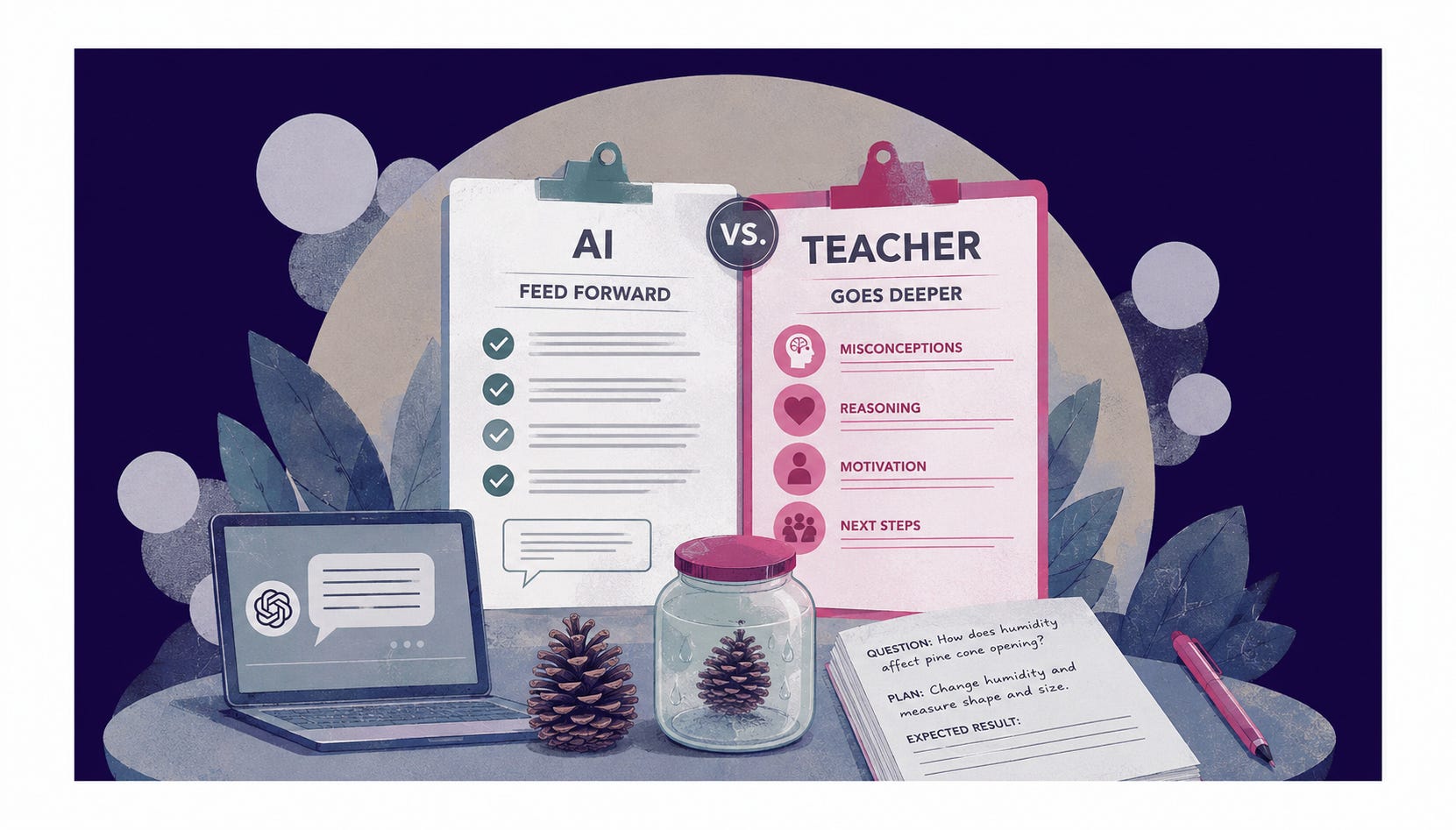
AI is also consistently well-suited to one category of feedback: what feedback researchers call Feed Forward, meaning next-step guidance. Telling a student to “cite a counterargument,” “separate your variables,” or “develop this paragraph with evidence” is scalable, consistent, and context-independent — it requires knowing what good work looks like, not what this particular student misunderstood. A 2025 study comparing LLM and teacher feedback on student science work found LLM and teacher Feed Forward feedback statistically indistinguishable. At generating next steps, AI performs at the level of an experienced teacher.
Beyond Feed Forward Feedback: What AI Catches vs. What a Teacher Catches
While AI is great at offering Feed Forward notes, supporting students beyond this gets more complicated.
The best study to elucidate this tested more expansive AI feedback directly on real student work. Researchers at Technical University of Munich gave the same student science protocols to an LLM and to experienced biology teachers, then had expert reviewers rate all the feedback blind. One of the protocols involved a pine cone humidity experiment. A common student error: proposing to study both pine cone shape and size simultaneously without isolating either variable, which means any result would be uninterpretable.
The LLM’s feedback told the student to separate their variables and test one at a time. That is the correct next step. It is the kind of rubric-aligned guidance that AI generates reliably.
A teacher reading the same protocol addressed the specific reasoning that produced the problem: “You’ve set up your study so that shape and size both vary. If you get a result, you won’t be able to say whether shape caused it, size caused it, or some combination. To fix this, pick one variable and hold the other constant.” That second version names what the student actually did and why it creates an interpretive problem.
When the expert reviewers rated all this feedback, overall quality scores were nearly identical — LLM at 3.78 versus teachers at 3.81 on a five-point scale. On the surface, equivalent. But when researchers measured content correlation — how much the LLM and teacher feedback addressed the same things in the same student work — the correlation was 0.06 to 0.21. Near zero. The language correlation, measuring how similarly they wrote, was 0.54 to 0.61. In other words, the feedback sounds alike, but they actually offer meaningfully different things.
On Feed Back support — identifying errors grounded in the student’s actual reasoning — LLM scored 3.05 versus teachers’ 3.52, a statistically significant gap. AI is good at telling students what to do next, but it is structurally weak at telling them what they specifically did wrong and retracing their steps.
The Risk in AI Feedback Without Review: The 20% Inaccuracy Gap
The surface similarity between AI and teacher feedback — fluent, confident, appropriately structured — creates a specific risk when no human reviews the AI’s output before it reaches students.
A 2025 study from the Leibniz Institute for Science and Mathematics Education built what is arguably the most carefully designed AI feedback system in the current published literature: an LLM-based system for physics problem solving, grounded in Evidence-Centered Design — a framework that anchors AI feedback to explicit knowledge types and problem-specific reasoning schemes rather than letting the model generate freely. It was built specifically to reduce the kinds of errors that unstructured prompting produces.
The researchers deployed it with 38 participants in the German Physics Olympiad and had expert reviewers check every piece of AI-generated feedback for physical correctness. In 51 of 64 feedback instances, roughly 80%, the feedback was accurate. In the remaining 13, it contained errors ranging from minor to substantial: wrong physics concepts, invalid assumptions, correct student approaches flagged as wrong.
Then came the question that matters for deployment: could students tell the difference?
Students rated the accuracy of the feedback they received at 4.4 out of 5. Whether the feedback was correct or incorrect made no statistically significant difference. Students receiving wrong feedback rated it just as accurate as students receiving right feedback.
Language models are trained to produce fluent, expert-sounding text. When an AI feedback system makes an error, it does not hedge or signal uncertainty. It produces the same confident, well-structured paragraph it would produce if correct. Students have no external signal to distinguish the two — and these participants were high-achieving physics competitors, among the most likely to catch an error if one was detectable.
Supporting, Not Replacing Teachers
None of this is an argument against AI in grading. It is an argument about what role AI plays well, and where it requires a human in the chain.
Let’s return to Brazil for a moment. The finding that human graders added nothing to AI scoring is not an argument for removing humans from the feedback loop. The Brazil RCT found that when AI handled essay scoring, teachers redirected their time: students in AI-supported schools had roughly 30% more one-on-one conversations with their teachers about their writing, with no increase in teacher workload. The AI did not replace the diagnostic role. It freed the teacher to perform it.
The Tsinghua co-grading experiment shows the same logic from a different direction. In a controlled study, novice graders — college students with no grading experience — achieved a grading accuracy score of 0.53 out of 1.0 against expert judgment. The same novices with LLM assistance reached 0.66, a level statistically indistinguishable from expert performance at 0.71. The AI’s rubric scaffolding and explanations closed a gap that training alone had not.
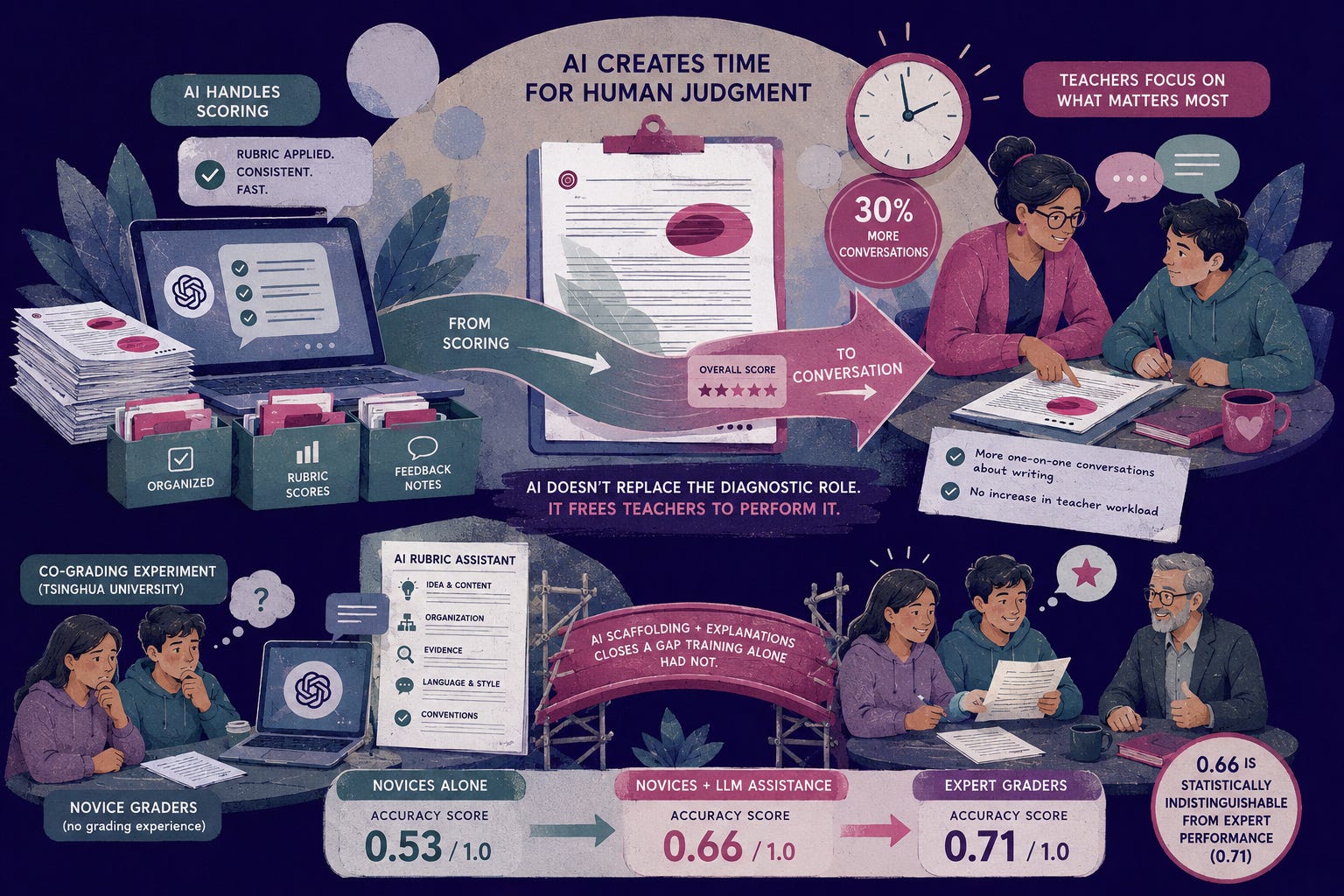
Expert graders with AI assistance showed a different pattern: accuracy improved but not significantly. What they found useful was the AI’s confidence scores for flagging essays that warranted closer review. The AI sorted and flagged areas for human expert decisions.
A tension in these two findings is worth naming. Adding experienced human graders on top of AI scoring produces no incremental benefit; adding AI assistance to novice graders produces significant gains. These are not contradictory: the teachers in the Brazil study were already near the ceiling of what essay scoring can achieve — the AI freed their time rather than improving their marks. The novice graders in the Tsinghua experiment started well below that ceiling; the AI’s scaffolding lifted them. AI’s amplification value is largest where the human expertise gap is largest.
Where the Loop Must Close
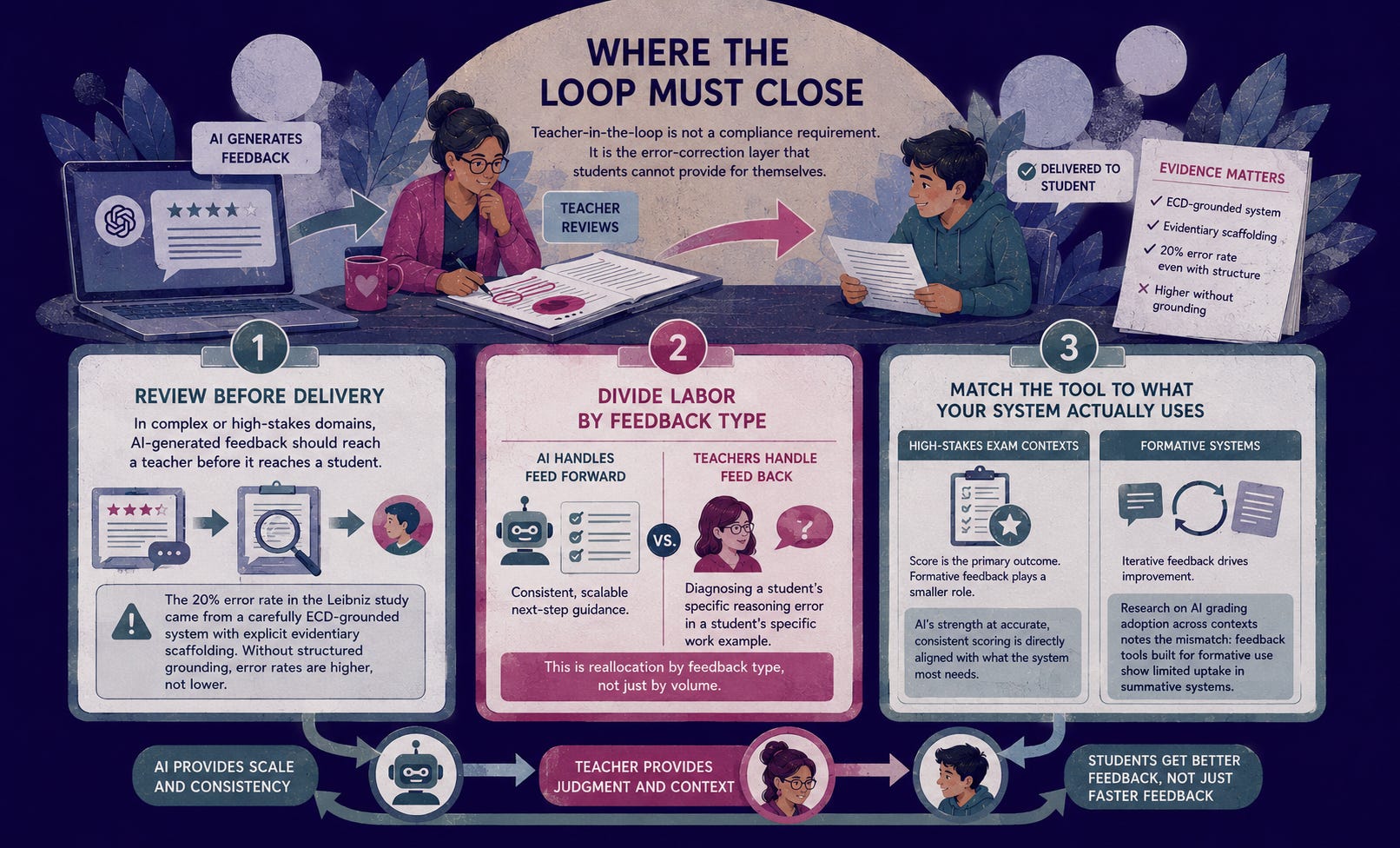
Teacher-in-the-loop is not a compliance requirement. It is the error-correction layer that students cannot provide for themselves. Here are three design choices for implementing AI grading tools in the classroom that evidence supports with this margin of error in mind:
Review Before Delivery: In complex or high-stakes domains, AI-generated feedback should reach a teacher before it reaches a student. The 20% error rate in the Leibniz study came from a carefully ECD-grounded system with explicit evidentiary scaffolding. Without structured grounding, error rates are higher, not lower.
Divide Labor by Feedback Type: AI handles Feed Forward — consistent, scalable next-step guidance. Teachers handle Feed Back — diagnosing a student’s specific reasoning error in a student’s specific work example. This is reallocation by feedback type, not just by volume.
Match the Tool to What Your System Actually Uses: Assessment cultures differ in how much they rely on iterative feedback to drive improvement. In high-stakes exam contexts — where a score is the primary outcome and formative feedback plays a smaller role in the learning cycle — AI’s strength at accurate, consistent scoring is directly aligned with what the system most needs. Research on AI grading adoption across contexts notes the mismatch explicitly: feedback tools built for formative use show limited uptake in summative systems.
The Question Worth Asking
The debate about AI grading has been organized around the wrong question. “Is it as accurate as a human teacher?” is not wrong, it is incomplete.
Accurate at scoring structured work with proper configuration: yes, the evidence is consistent. Accurate at diagnosing what a specific student got wrong in their specific reasoning: no — not reliably, not without human review in complex domains, and not in ways students can independently verify.
Scoring accuracy and feedback accuracy are not the same thing. They are not measured by the same test, and a tool can pass one and fail the other. Most evaluations run only the first test and draw conclusions about both.
Before deploying an AI feedback tool, three questions are worth asking:
Which job is this tool doing — scoring, feedback, or both?
If feedback, who reviews it before it reaches students, and do they have the domain expertise to catch errors?
What does the teacher do with the time the tool frees — and is the school designed for that reallocation to happen?
Schools have learned to ask whether the AI scores accurately. The question they haven’t started asking — whether it explains accurately — is the one that matters to the student trying to understand what went wrong.
Special thanks to Overdeck Family Foundation for sponsoring this article, the third of seven in our AI & Efficacy Editorial Research Series diving into key research findings from Stanford’s AI Hub for Education Research Repository (a project by Stanford’s SCALE Initiative). Stay tuned for more!
Top Edtech Headlines
1. Bett Has Launched in the U.S.
Backed by 100+ founding educator and industry leaders — including 50+ Launch Partners and 50+ Bett Builders — Bett USA is launching with momentum from across the K–12 ecosystem.
Taking place November 8–10, 2027 at the Music City Center in Nashville, Bett USA is the new national home for innovative K–12 educators — bringing together the leaders who set direction, evaluate solutions, and bring learning to life alongside the companies building what’s next.
2. Request for Proposals: AI in Math Education
Applications are now open for a new Request for Proposals from the K-12 AI Infrastructure Program. This RFP focuses on developing open-source Gold Standard datasets, evaluations and benchmarks to improve AI in math education.
Up to $2M for Adaptive Learning Experiences & Feedback for Students (1 award), up to $1.5M for Lesson and Instructional Planning for Teachers (1 award), and up to $2M for Teacher Coaching (1 award).
3. Apply Now: Global EdTech Prize
The Global EdTech Prize, founded with the support of Owl Ventures, has opened applications for edtech tools, products, and services online in anticipation of the next prize which will be awarded in January 2027! Applicants will be judged on purpose, quality, impact, innovativeness, and scalability.
4. Edtech Insiders Co-Founder Ben Kornell at NewSchools Summit!
Our very own Ben Kornell recently spoke as part of the "Visions for What Comes Next" morning plenary at NewSchools Summit 2026, examining how AI is forcing a rethink of assessment and the purpose of school. Check out his talk below!

Lisa Gevelber on Why AI Fluency Is the New Workforce Skill
Lisa Gevelber is the founder and leader of Grow with Google, Google’s economic opportunity initiative focused on helping people build skills, careers, and businesses. Through Google Career Certificates and AI training programs, she has helped millions of learners develop workforce-ready skills and navigate an increasingly AI-driven economy.
5 Things You’ll Learn in This Episode:
Why AI fluency is becoming an essential workforce skill for every profession.
How Grow with Google is helping learners build practical AI skills at scale.
The growing role of AI credentials and certificates in higher education.
How universities are integrating AI training into student, faculty, and alumni learning.
Why lifelong learning and career mobility will be critical in the age of AI.