

The Two Fronts Reshaping EdTech Policy in 2026: Screentime Scrutiny and California’s AI Bridge
New regulations around screen time and AI could push edtech companies towards better outcomes—if they can demonstrate real educational value


Thanks to our Presenting Sponsors Hire Education, Starbridge, Cooley, and Tuck Advisors for making Edtech Insiders’ content and community possible.


The Two Fronts Reshaping EdTech Policy in 2026: Screentime Scrutiny and California’s AI Bridge
By: Ben Kornell
As edtech enters 2026, two converging policy forces threaten to fundamentally reshape how digital tools are used in American classrooms. The first is the anti-screentime movement, which has expanded from its original focus on social media and smartphones to now encompass edtech as a whole. The second is California’s emerging role as the de facto national regulator for AI in children’s products, a strategy that could bring Silicon Valley’s AI companies and the edtech industry under the same regulatory umbrella.
Together, these forces represent the most significant policy challenges the edtech sector has faced since the pandemic-era digital transformation. And, unlike previous regulatory skirmishes, this time edtech cannot count on being treated as distinct from big tech.
When “Educational” No Longer Provides Cover
For years, edtech companies operated under an implicit assumption: screens used for learning were fundamentally different from screens used for entertainment. That assumption seems to be crumbling.
Last week, the Senate Commerce Committee convened a hearing titled “Plugged Out: Examining the Impact of Technology on America’s Youth.” While the stated focus was smartphones and social media, the testimony repeatedly crossed into edtech territory, signaling that policymakers increasingly view all screens as part of the same problem.
According to testimony from Dr. Jean Twenge, Professor of Psychology at San Diego State University, children aged 8-12 now spend an average of 5.5 hours daily on screens, while teenagers clock 8 hours and 39 minutes, meaning more than half of a teenager’s waking hours are spent staring at a screen. Academic performance among 8th and 12th graders began declining around 2012, correlating with increased device use during the school day.
Dr. Jenny Radesky, Associate Professor of Pediatrics at the University of Michigan Medical School, delivered particularly pointed testimony about edtech’s role in this crisis. “So many of my patients use video games, YouTube, or AI chatbots on their school-issued devices, and it’s getting in the way of them engaging with the curriculum,” she testified. “We need intentional strategies that prevent use of edtech for behavior management or downtime because that’s what I’m also hearing from patients.”
This framing—edtech as part of the screentime problem rather than an educational solution—represents a huge change in how policymakers are approaching classroom tech. Emily Cherkin, author and founder of The Screentime Consultant who also testified at the hearing, put it bluntly: “As schools double down on edtech products, reading and math scores are plummeting.” (It’s worth noting that her LinkedIn profile headline is: “Fighting to dismantle the EdTech industry to save children, education, and democracy.)
The policy response is already taking shape. The Kids Off Social Media Act (KOSMA), reintroduced by Senators Ted Cruz and Brian Schatz, would not only set a minimum age of 13 for social media use but would also block social media access on federally funded school networks and devices. While the bill’s primary targets are platforms like TikTok and Instagram, its provisions around school-issued devices signal growing congressional willingness to regulate what happens on Chromebooks and iPads, not just smartphones, and this regulatory reach is already spilling over into edtech apps, too.
The National Telecommunications and Information Administration (NTIA) has launched an inquiry into school-based technology use, explicitly questioning whether federal subsidies are pushing schools toward more screens without evidence that it helps children learn. “The pace and scale of edtech adoption—accelerated by the pandemic—haven’t been matched by serious scrutiny,” NTIA stated in announcing the initiative.
For edtech companies, the message is clear: the regulatory distinction of being “educational” is no longer holding water. As Jonathan Haidt, author of The Anxious Generation and a leading voice in the anti-screentime movement, has argued, “It’s very hard for a child to learn anything with a computer or tablet in front of them, because the distraction effects are enormous. They swamp any possible benefit.”
California’s Policy Bridge: From Ballot Box to National Standard
At the same time, regulation around AI use with kids and teens is also on the horizon. Federal actions so far have been very pro-AI industry, but California is positioning itself to fill the AI regulatory void—with implications that will extend far beyond state borders.
On January 9, 2026, an unlikely alliance announced plans for a California ballot initiative that could reshape how AI companies interact with minors. OpenAI and Common Sense Media—previously operating competing ballot measures—joined forces to propose the “Parents & Kids Safe AI Act.” The consolidated measure would require age assurance, ban targeted advertising to minors, prohibit sharing children’s data without parental consent, and mandate safeguards against harmful AI content including promotion of self-harm or sexually explicit material. (I will call out my own bias here as I worked for Common Sense from 2022-2025).
“This is an initiative in California but our aspiration is that this will not just be in California. This can be a model for other states,” said Chris Lehane, OpenAI’s chief global affairs officer.
That aspiration reflects a well-established phenomenon in American regulatory policy: the “California policy bridge,” California’s ability to set de facto national standards. As the Brookings Institution noted in its analysis of California’s AI regulatory efforts, the state’s unique position as home to 32 of Forbes’ top 50 global AI companies gives it extraordinary leverage. When California regulates, companies often find it easier to apply those standards nationwide rather than maintain separate systems for different markets.
“California has often served as a testing ground for technology policy later adopted elsewhere,” noted a statement from Governor Gavin Newsom’s office regarding the state’s approach to AI oversight. This “policy bridge” strategy has worked before—California’s consumer privacy regulations under CCPA became a template that influenced similar laws across the country.
For edtech, the implications of California’s AI initiative are significant. The ballot measure’s provisions around age assurance, data sharing, and content safeguards will apply to AI-powered educational tools just as they apply to chatbots and social media platforms. Any edtech company using AI features—from adaptive learning algorithms to AI tutoring—will need to comply with whatever standards California ultimately adopts.
The enforcement mechanism is also notable. The new measure with OpenAI would hold companies accountable through the Attorney General and financial penalties, moving away from Common Sense Media’s original proposal that included a private right of action. This approach mirrors the kind of regulatory oversight that edtech companies have largely avoided but may soon face.
The Uncomfortable Spotlight
What makes the current moment particularly challenging for edtech is the absence of any differentiation in the policy conversation. Whether in Washington or in Sacramento, U.S. Edtech has failed to coalesce around common messages around edtech best practices and teacher support. In contrast, Beth Havinga and the European Edtech Alliance are regulars in policy discussions in Brussels and across the continent.
Simultaneous to this fragmented messaging, U.S. edtech continues to struggle with measuring and communicating efficacy. As the Congressional hearing testimony noted, academic performance has declined in parallel with increased device adoption, not improved. The burden of proof is shifting and edtech companies, individually and collectively, need to bring better data to demonstrate the positive use cases for edtech and AI for kids.
Looking Ahead
For edtech leaders, 2026 will require navigating a policy landscape that no longer treats edtech as categorically different than consumer technology. The anti-screentime movement has expanded its scope, and California is building a regulatory framework that will apply to any AI product used by minors—educational or otherwise.
The companies that fare best will likely be those that can demonstrate genuine educational value with rigorous evidence, design products that minimize distraction rather than maximize engagement, and proactively comply with emerging standards around age verification and data protection.
If rolled out in the right way, this is frankly a potentially exciting development, where quality of outcomes drives the growth of edtech tools rather than their capital or distribution advantages, as can sometimes be the case. That being said, if edtech is lumped in with all social media, AI, and consumer tech, we are in for a bumpy ride in 2026!
We love to collaborate. To learn more about partnership and sponsorship opportunities, please email info@edtechinsiders.com. Thanks for reading!

EdTech entrepreneurs, don’t miss your chance to apply to the Milken-Penn GSE Education Business Plan Competition now through February 11, 2026. Semifinalists receive personalized mentorship through Catapult, Catalyst @ Penn GSE’s virtual accelerator, and connect with a global network of founders and investors, with the opportunity to compete for up to $200k in cash and prizes.
The 2026 GSV Cup 50: Meet the World’s Most Innovative Early-Stage EdTech Startups
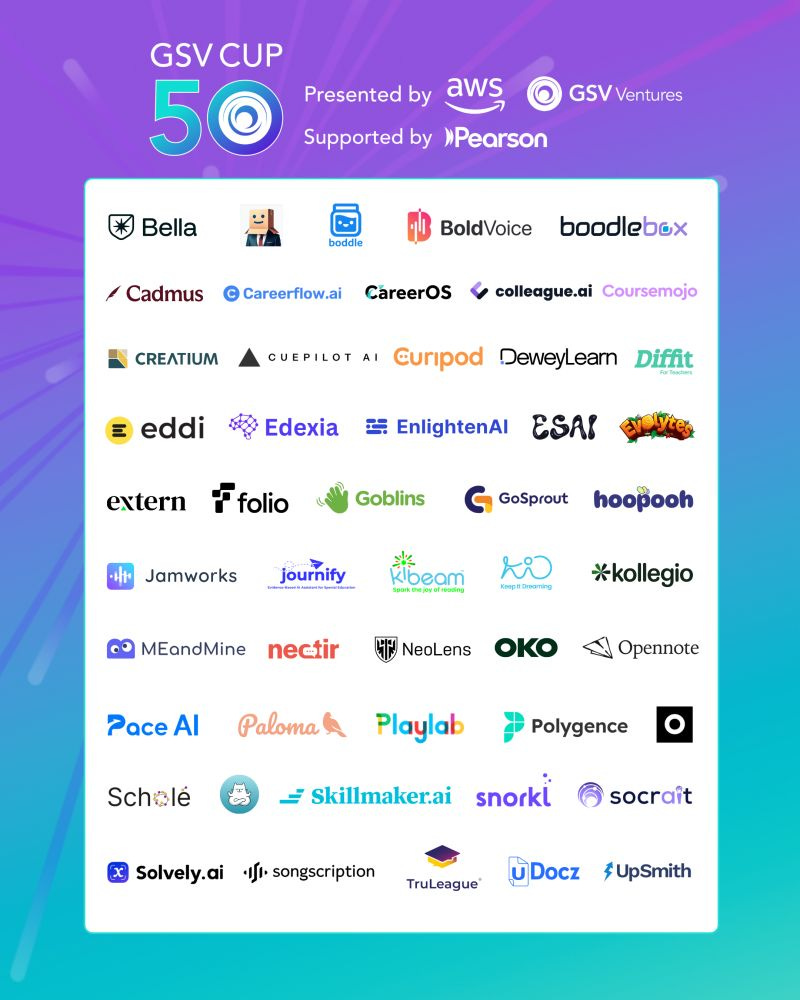
The 2026 GSV Cup 50, presented by AWS and GSV and supported by Pearson, has been announced, spotlighting the most innovative early-stage (pre-seed and seed) companies transforming digital learning and workforce skills across five continents.
The Numbers Tell a Story
This year’s cohort is impressive by any measure:
3,000 nominations for the 50 slots (a 1.6% acceptance rate!)
$177M+ in capital raised (disclosed)
76% founded by women or people of color
The startups span the full “PreK to Gray” spectrum: 38% focused on K-12, 16% on higher education, 20% on workforce and adult learning, and 26% operating across multiple segments. Companies are headquartered across the US, Iceland, Australia, Switzerland, India, Norway, Germany, Canada, Spain, Mexico, and the UK—with 60% built for global markets.
The Next Generation of AI in Edtech
What stands out most in this year’s cohort is the fusion of AI and education. These aren’t companies bolting AI onto existing products—they’re building AI-native solutions from the ground up.
AI is quickly becoming “normal” in EdTech. It’s no longer about being an “AI company” or not—it’s about how you use AI to improve learning outcomes, build engagement, and expand impact. In just a few years, AI has moved from differentiator to infrastructure.
But what’s most notable about this year’s GSV Cup 50 is how many of these companies are using technology to do something deeply human: strengthen relationships. Whether it’s connecting learners to each other, deepening the bond between students and teachers, helping parents support learning at home, or supporting mental health and wellness, there’s a clear throughline in this cohort.
You’ll find AI-powered tutors, voice coaches, assessment tools, classroom copilots, and workforce training platforms—but look closer and you’ll see tools designed to spark collaboration and build community.
These founders aren’t just optimizing for efficiency; they’re designing AI features that facilitate experiences, matchmake between learners, craft richer classroom discussions, and foster a persistent sense of community and wellbeing. These are the kind of meaningful experiences that make learning stick and bring joy back into learning.
That combination of AI-native architecture with a human-centered purpose feels like the defining signature of this moment in EdTech.
From Demo Day to Scale
The GSV Cup has become the premier launchpad for early-stage EdTech founders. Alumni of past GSV Cups have gone on to raise hundreds of millions, forge global partnerships, and build solutions reaching millions of learners worldwide.
What’s Next
All 50 companies will take the stage on GSV Cup Demo Day—Tuesday, April 14—at the ASU+GSV Summit in San Diego (April 12-15, 2026), presenting to a global audience of investors, educators, and industry leaders.
Explore the full list of 2026 GSV Cup 50 companies at asugsvsummit.com/gsv-cup.
Upcoming Events

Teaching & Learning in a Multimodal World
How do we design learning that actually meets learners where they are?
Join us on January 30 for a live panel exploring how video, audio, AI, and interactive media are driving engagement and reshaping learning design. Hear from leaders at Google, HeyGen, Novodia, and Creatium as they share practical insights on what’s working today — and what’s coming next.
Top Edtech Headlines
1. New Research: Teachers Use AI to Amplify Critical Thinking, Not Replace It
A new SchoolAI study analyzing 23,000 teacher-created AI learning experiences shows educators are leveraging AI as a catalyst for deeper reasoning and analysis, not shortcuts. Over 75% of AI activities are anchored in core curriculum, prompting students to reason, evaluate, and make decisions rather than simply recall information.
2. EdTech MBA Spring 2026 Fellowship Now Open
The EdTech MBA Fellowship is now accepting employer project proposals through January 28 for Spring 2026 placements. Since Fall 2022, the program has placed 200+ MBA students from top graduate programs with edtech startups, growth-stage companies, and VC firms for real, high-impact projects. Collaborate with high-caliber talent who care deeply about edtech.
3. Get Ready for ADA Title II in April 2026 with Workback.ai
EdTech products serving K12 districts, state universities, or public institutions must comply with ADA Title II by April 2026. Workback.ai, founded by former Coursera engineering leaders, completely automates accessibility compliance, reducing the typical six-plus-month process to weeks.
Why Education Is in an Imagination Crisis and How 4.0 Schools Is Responding
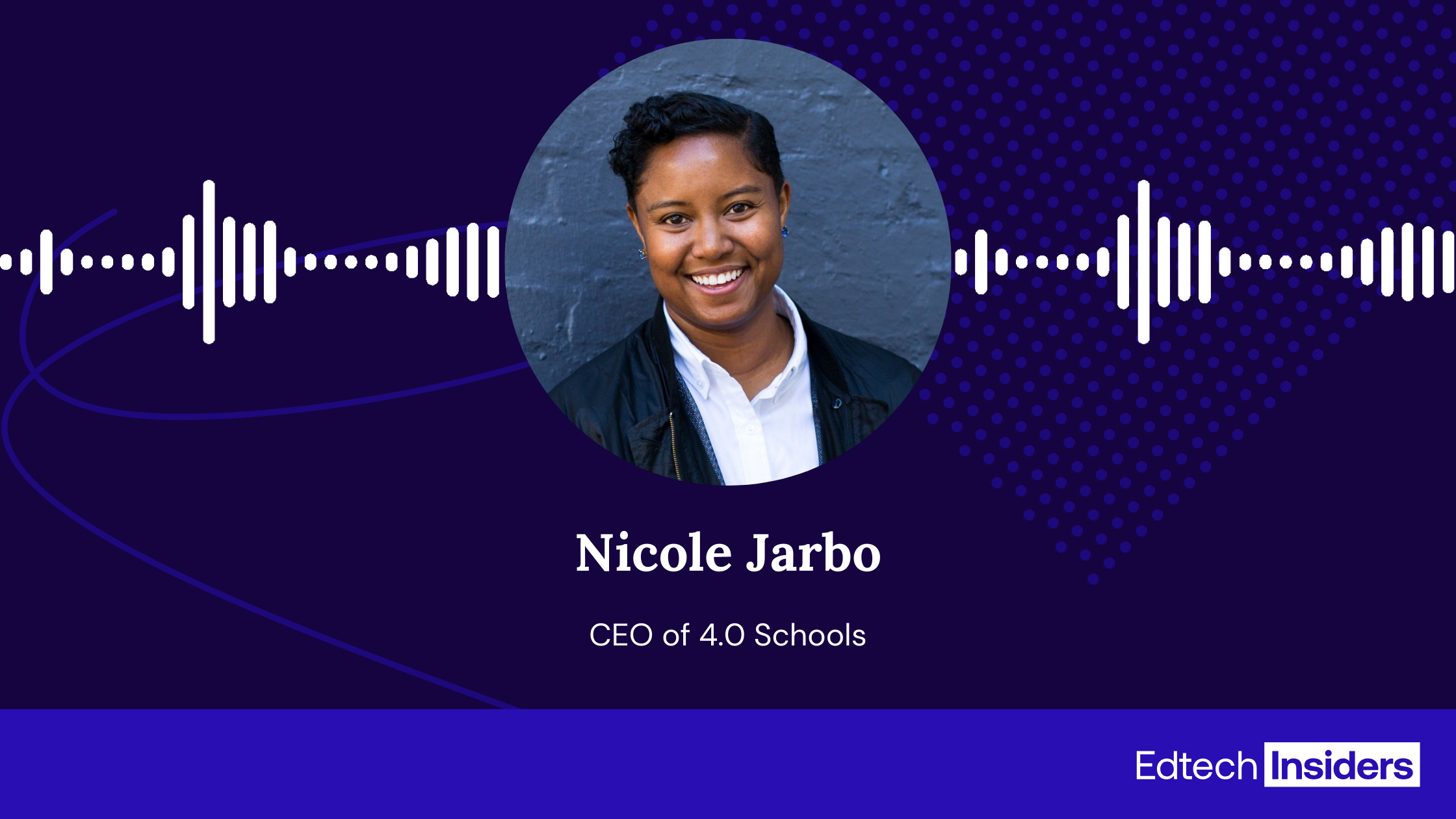
We recently had Nicole Jarbo, CEO of 4.0 Schools, on The Edtech Insiders Podcast! 4.0 Schools is one of the nation’s leading platforms for early-stage education founders. A former KIPP teacher, Teach For America Corps member, and fintech founder, Nicole brings deep experience across classrooms, startups, philanthropy, and systems-level education change. She is also the host of the award-winning podcast Pitch Playground.
5 Things You’ll Learn in This Episode:
Why education is facing an “imagination crisis” — and why technology alone won’t solve it
How 4.0 Schools supports founders beyond pilots to build durable, real-world impact
What successful education founders have in common across industries
Why “anti-scale but pro-impact” may be the right mindset for the future of education
How founders and educators can approach AI with greater intentionality and responsibility
We love to collaborate. To learn more about partnership and sponsorship opportunities, please email info@edtechinsiders.com. Thanks for reading!