


Get 10% off your EdTech Week Ticket with code EDTECHINSIDER10


The Rapid Rise of AI Councils and Why They Are Edtech’s New Front Door
By: Mario Vasilescu
Mario Vasilescu is CEO & Co-Founder of Readocracy, an ethical/humane tech company on a mission to create a world where being well-informed beats being loud. They are the creators of ShowYourLearning, the first 100% reliable, 100% explainable, AI detector-free solution to AI cheating concerns, for both students and educators.
AI Councils, also called AI Committees or AI Task Forces, have become one of the fastest-growing trends in education. As an Edtech founder building tools for critical thinking and AI-proof learning, I speak with schools almost every day. Over the past year the topic of AI Councils has exploded: nearly every school now either has one they’re trying to better support, or are trying to set one up for the first time.
Whether you’re school-side or edtech-side, this deserves more of your attention. A new deliberative body is forming between products and classrooms. Most of these bodies are under-resourced and improvising, and how well they function will shape what schools adopt, what they ban, and how much trust the Edtech sector has to work with.
What AI Councils Are, and Why Schools Need Them
AI Councils exist not only to review administrative proposals around AI use, but to facilitate dialog around what AI means to their school, its values, and its policy in an ongoing fashion. While in some schools an Educator AI Council and a Student AI Council both exist and operate in parallel, in others, a single AI Council includes both students and educators (a format which I believe to be most impactful). In some K-12 districts, parents may even be included.
AI Councils usually recruit early adopters: the people that peers already turn to for AI advice. Other members may be invited, or may join themselves, to represent parts of the education community that are not already represented by these more highly engaged AI users. Here’s what makes these AI Councils essential:
Nobody Watches AI if Nobody Is Responsible for It
Administrators, educators, students, and parents are all spread thin. AI is too complex, intimidating, and fast-moving to handle on an ad hoc basis, and existing policy gathers dust in a digital corner unless a group is explicitly tasked with revisiting it. The consequences of this show up in the data: Stanford’s 2026 AI Index Report found that only 6% of teachers said their school’s AI policies were clear.
That inconsistency cascades. Students face different rules in every classroom, and parents are left to wonder what is happening at their child’s school. AI Councils build the basis for community-wide consistency and clarity to emerge.
AI Councils Are the Only Real Defense Against a Culture of Distrust
In conversations with students, educators, and school leaders across the U.S. and Canada, the most harmful impact of AI is arguably the creation of a toxic learning environment dominated by distrust. Educators are at their wits’ end over academic integrity, while students are given unclear guidance and feel they might be falsely accused of AI cheating at any moment.
The open dialogue between educators and students in AI Councils are the best avenue to defuse this toxicity and get past generalizations that dominate mainstream discourse. For example, in the process of speaking to educators and students about ShowYour Learning, our academic integrity tool, we often heard that AI use had little to do with deliberate cheating:
Educators collectively assigning more work than can realistically be completed, forcing students toward shortcuts, now prominently available courtesy of AI providers
The pressure of seeing peers use AI to polish outputs, and achieve higher grades, forces the hand of students who would otherwise use it more sparingly
Students raised in a frictionless digital environment are asked to persevere through the heavy friction that learning entails, while enticing AI shortcuts exist at every turn
Without representative conversations, such underlying considerations remain unaddressed, and the confusion, alienation, and adversarial culture between educators and students deepens.
AI Councils Provide A Decision-Making Firewall
Just because a school has an AI Council does not tell you whether the school endorses AI usage. For many schools, the existence of an AI Council is a way to ensure that the educator and student perspective are not lost in a dialogue that often feels overshadowed by the influence of “Big Tech”. The inclusive, deliberative nature of AI Councils also allows for an approach that is more representative of Critical AI Literacy, which is quickly catching up to AI Literacy in schools (AI Literacy is focused on how to use the tools; Critical AI Literacy is focused on how the tools use you). In other words, it is equipping schools to make wiser, healthier technology choices.
AI Councils Respect And Reflect A Student-Shaped Reality
Studies point to as many as 92% of students using AI in their studies in 2025, up from 66% the previous year, and they are well aware of the risks, naming the impact on their cognitive wellbeing as a top concern. This summer, 98 students frustrated by federal inaction gathered at the United States Senate in Boston to draft their own AI policy. Technology moves exponentially while bureaucracy moves linearly, if at all, and students feel the lag acutely.
All of this underscores the critical importance of AI Councils as a force for representing and centering the student perspective, ensuring students can work with educators to move things forward with support—rather than leaving the open internet, the most adversarial and readily blindspot-inducing information environment in modern history, as the main source of guidance.
Councils That Work vs. Councils That Don’t, And The Role You Can Play In Helping Them
For all their good intentions, AI Councils face a common dilemma: they often lack the resources, structure and authority that might allow their work to go beyond discussions, word of mouth, and basic recommendations for the school. The Councils that achieve the most impact have five things in common:
Space to Operate: Administration that supports carved-out time and a place to meet.
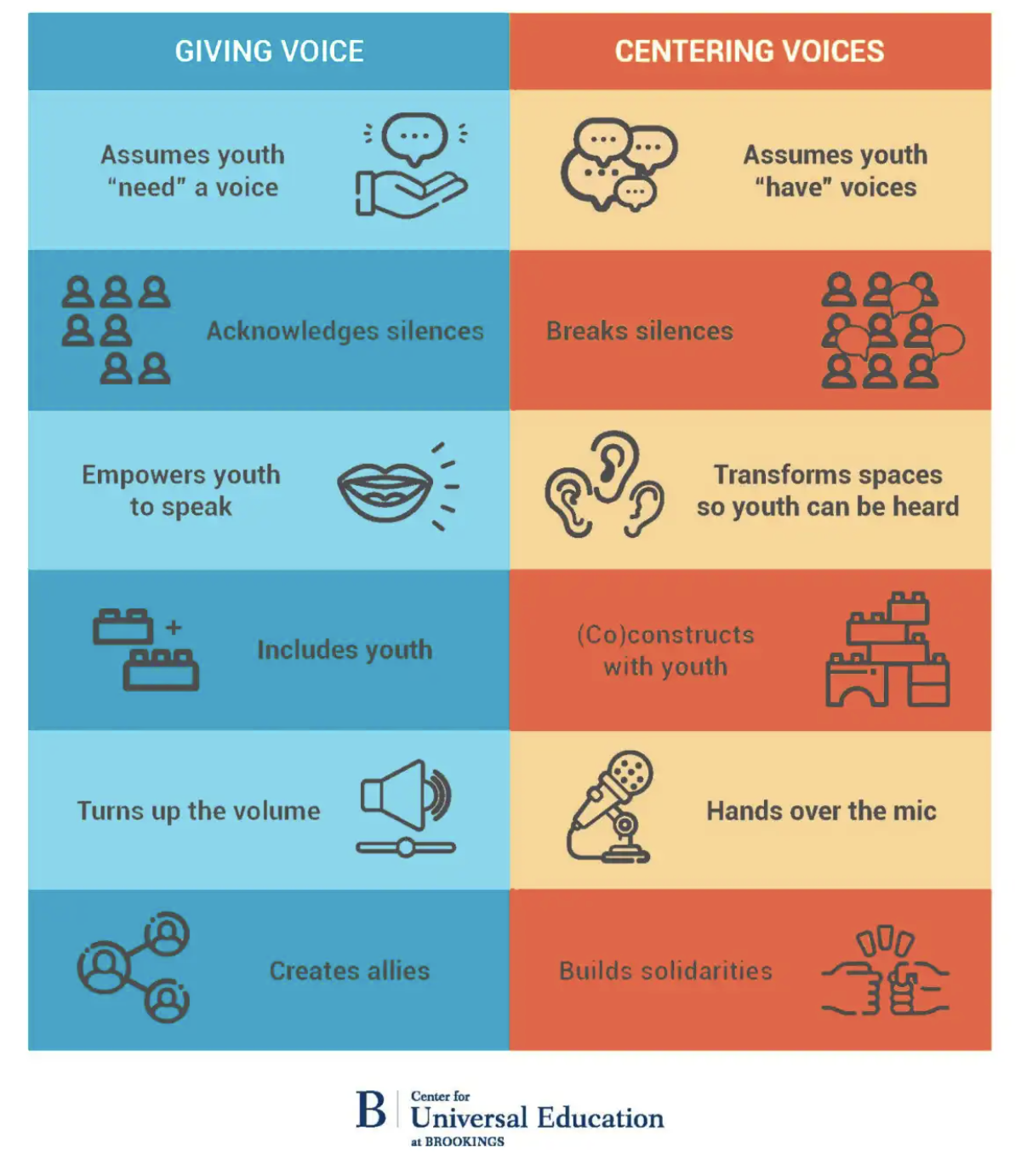
Student Equity and Authority. Winthrop’s Brookings piece includes an excellent chart from work by Emily Markovich Morris and Omaer Naeem contrasting “giving voices” with “centering voices.” If student involvement isn’t framed as a respected seat at the table, with recommendations that can actually be actioned, the whole activity falls apart. This includes leaning into experimentation, and testing new products together.
Incentives: Formal designations and titles that help with professional advancement or college admissions, such as Faculty AI Leadership Group or Student AI Fellow, plus funded professional development, lunches, tool budgets, or conference attendance.
Clear Responsibilities: The group understands its role and acts on it: acting as custodians of the community’s AI use, weighing both the opportunities and risks of AI in all its evolving forms on an ongoing basis, with the school’s values and AI policy in mind.
A Way for the Impact to Scale: Many Councils stay isolated, offering word-of-mouth influence outside their recommendations to administration. That wastes the biggest intended benefit, which is community-wide awareness and consistency.
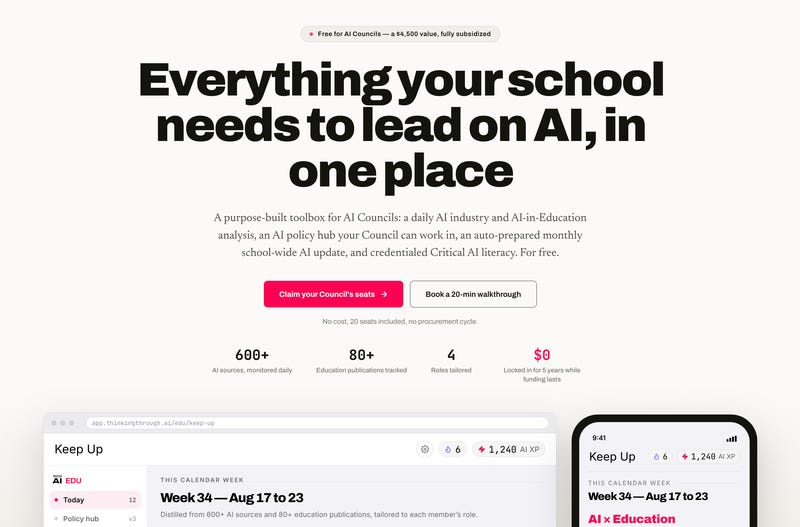
Edtech companies can play a role in many of these factors, acting as a supportive forcing function —ranging from offering to speak to AI Councils directly, preparing materials for them, offering them testing access, or leveraging your expertise to provide helpful PD. In our case, we built TTAI EDU to try to provide the missing infrastructure that can help AI Councils scale their efforts more effectively while more easily accessing Critical AI Literacy materials from the field’s top providers.
Why This Matters if You Build, Fund, or Study Edtech
School decision-making is changing shape. AI and related technology commitments are increasingly getting a more well-rounded review as they route through AI Council members, whether vendors know it or not. Whether collective or individual, their perspectives are better informed than procurement processes used to be.
Distrust is a market risk, not only a school problem. Institutions without a functioning way to reason about AI default to bans and blanket suspicion. Everyone in this sector who believes technology can be applied responsibly has a commercial stake in schools having a deliberative body instead of a reflex.
Policy alignment is a success variable. If you can work with, or proactively assist an AI Council in navigating how your offering fits their school’s AI policy, and school values, you will help overcome the lack of clarity and precedent that they are actively battling and remedying. Without this, you risk slowing and complicating your review process.
AI Councils are the best design partner in education. They are the only group in a school that is both current on AI and representative across roles. For researchers and thought leaders, they are where the real negotiations over AI in education are happening, well ahead of the literature and broader policy decisions.
For investors and foundations, it is worth noting that capital has gone almost entirely to tools and training, and barely at all to the connective tissue institutions need in order to make decisions and progress. The AI Council trend is a demand signal.
Going Further, Getting Involved
TTAI EDU is an impact initiative from the mission-driven team at Readocracy, with support from EdTech Insiders, Ed Farm, EducAIted, and other education impact organizations, and features content curated from Ed3, Middle States Association, and other leading education groups, as well as custom values-based benchmarking around UNESCO, OECD, and MIT policy guidance.
If you work in a school, you can bring it to your Council at no cost through thinkingthrough.ai/edu. If you are building, funding, or researching Critical AI Literacy solutions in this space, and want to work on this layer with us, reach out through thinkingthrough.ai/edu/partners.
Thanks for reading! Support our work by becoming a paid subscriber, or email info@edtechinsiders.org to learn more about partnerships and sponsorships.
Insider Announcements
Hey Insiders! We’ve partnered with the team at StartEd to offer you all 10% off your ticket to EdTech Week 2026! We’ll be there, and we know many of you will be too.
This code is active for all ticket types. Grab your ticket now!
Upcoming Events
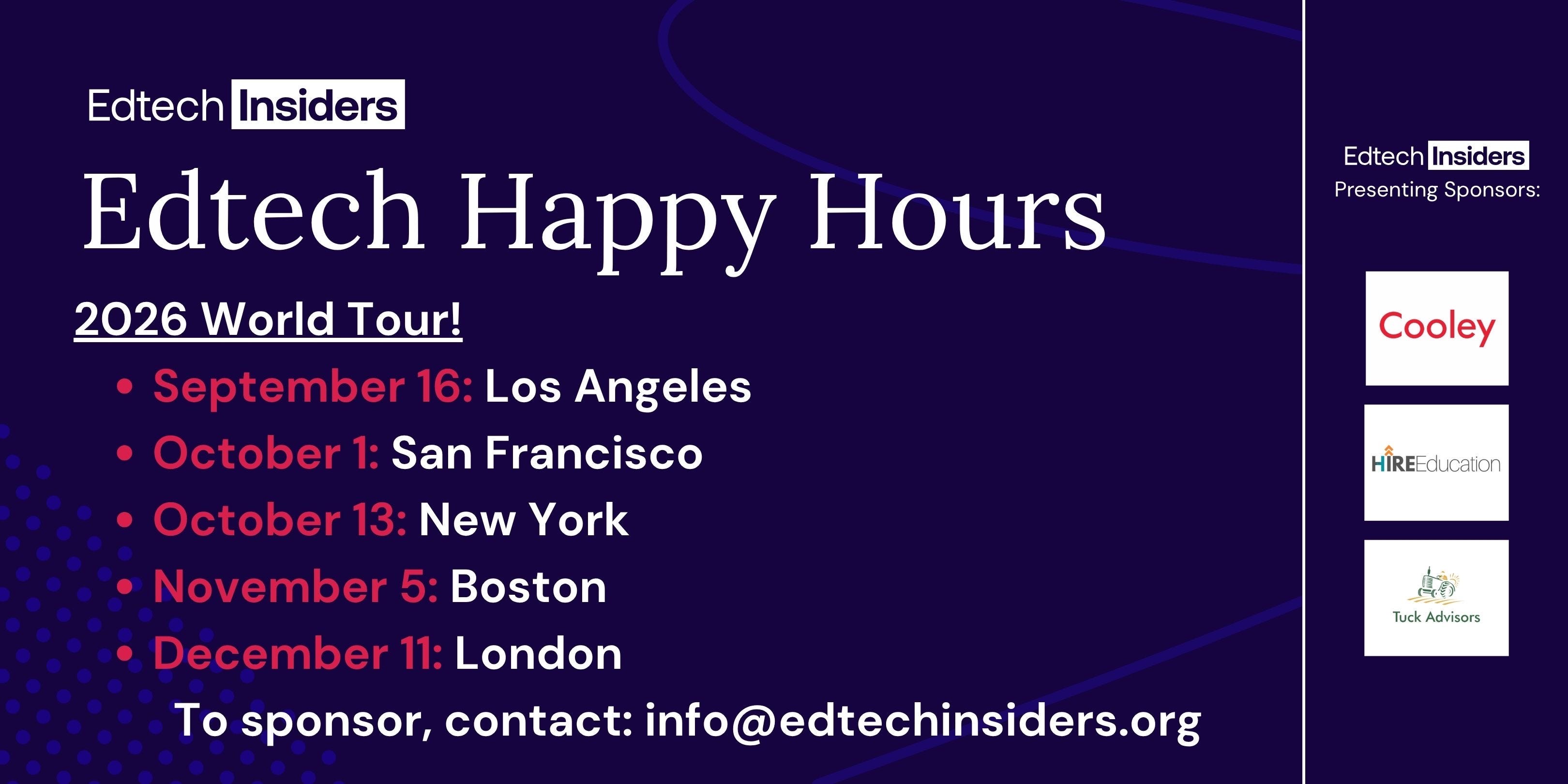
We have a whole host of webinars and Happy Hours coming up. More soon, but for now, save the date to our upcoming in person events!
Top Edtech Headlines
1. New York City Bans A.I. in Elementary and Middle Schools
New York City is moving to restrict student-facing generative AI tools in schools, banning chatbots and AI tutors through eighth grade while allowing more limited use in high schools. The policy reflects growing concerns that AI could undermine learning and student development, but it also puts pressure on schools to define what responsible AI use—and AI literacy—should actually look like as the technology becomes increasingly embedded in education.
2. LAUSD adopts moratorium on student AI use, another big move to limit classroom computer time
Los Angeles Unified has imposed a districtwide moratorium on student use of generative AI on district-owned devices for the current school year, while continuing to allow teachers to use AI. The move goes further than New York City’s newly announced restrictions and comes amid a broader push to reduce student screen time, with the district now weighing how AI should fit into its longer-term approach to digital literacy and learning.
3. Anthropic opens free Claude for Teachers Enterprise access to U.S. schools and districts
Anthropic has expanded its free Claude for Teachers program from individual educator accounts to centrally managed deployments for qualifying U.S. K–12 schools and districts. The Enterprise offering gives administrators tools for managing access, policies, and permissions while providing educators with AI teaching skills, state standards-aligned resources, and new lesson-planning and math-focused tools; Anthropic is also planning an evaluation with Detroit Public Schools to study the technology’s effects on educator practice and well-being.

HigherEd Series: What Would Higher Education Look Like If We Started Over?
Dr. Sasha Thackaberry-Voinovich founded Newstate University in 2026, bringing 20+ years of education leadership from executive roles at SkillsWave, Pearson, LSU and SNHU. She holds a PhD from Kent State and authored “The Power Worker” and “How to Grow Enrollment in Online Higher Education.” On this podcast, she joins our host Matthew Rascoff to dive into the current landscape of Higher Education.
This episode is part of the Edtech Insiders HigherEd Podcast Series, featuring conversations with leaders shaping the future of higher education.
5 Things You’ll Learn in This Episode
Why higher ed should be built from first principles.
How Newstate is rethinking the cost and structure of college.
The case for a one-course-at-a-time model.
How AI could reshape higher ed and credentials.
Why institutions need to narrow their focus and align incentives.
Thanks for reading! Support our work by becoming a paid subscriber, or email info@edtechinsiders.org to learn more about partnerships and sponsorships.