


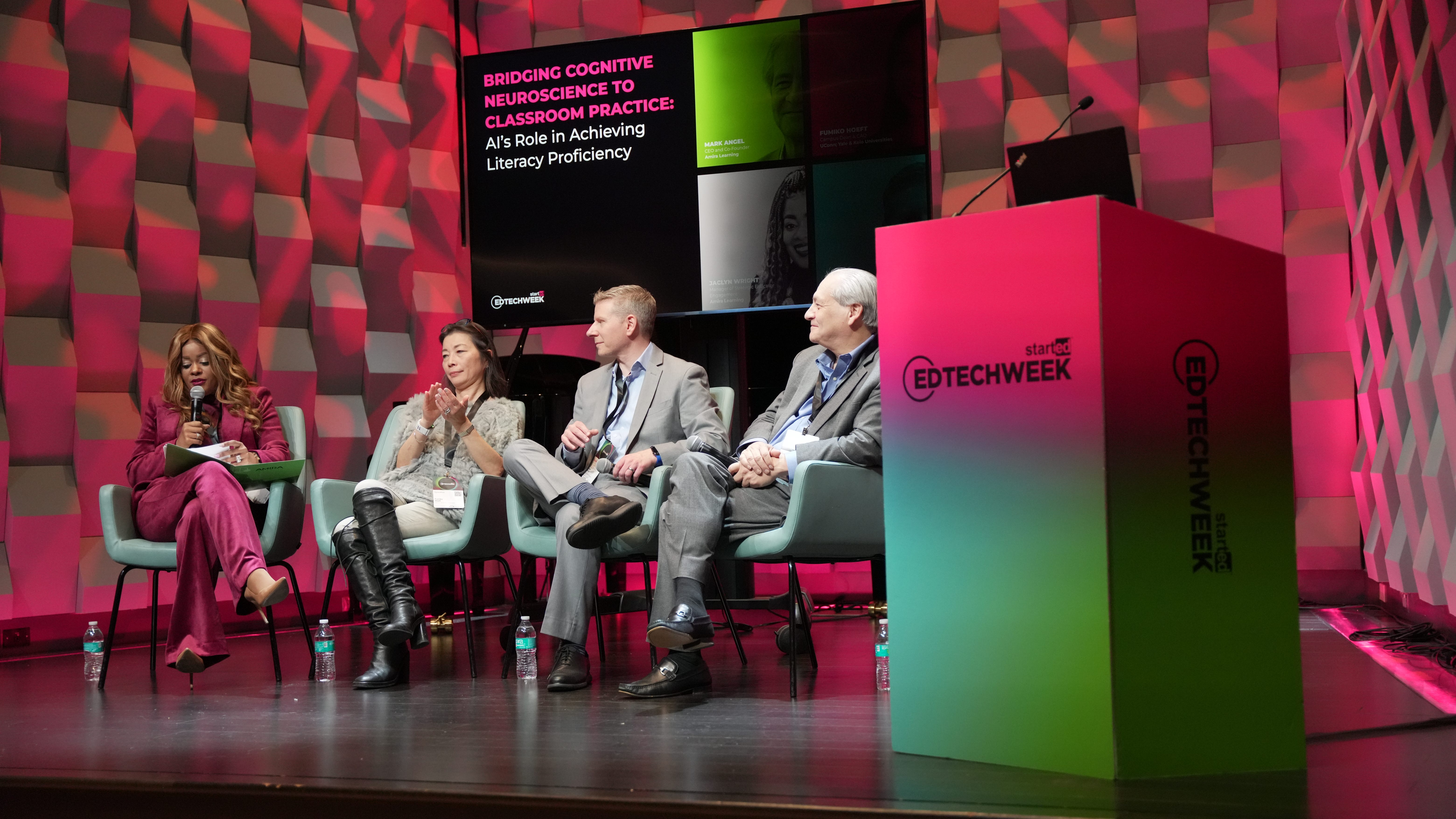
Takeaways from EDTECH WEEK: Evidence Gets You In. Outcomes Get You Renewed. AI Gets Vetted.
By: Alex Sarlin and Karl Rectanus
Karl Rectanus is CEO of Really Great Reading (RGR), an impact-centered leader driving measurable literacy outcomes for all students. An educator, entrepreneur, and advisor, he previously co-founded and led LearnPlatform, one of Fast Company’s 2023 World’s Most Innovative Companies, where he pioneered rapid-cycle evaluation and evidence-based decision-making in K–12 education.
Four themes ran through nearly every conversation at EDTECH WEEK in NYC this month. And, unlike other recent conferences, AI was just one of the four. The undercurrent of AI was certainly there, but rather than excitement run amok, the realities of the market were creating more questions than answers for solution providers, purchasers, and investors.
AI: How much should we use, sell, and buy? Will policies shift or allow AI tools for students? Is it even good at this education thing?
Evidence: Buyers want proof before they buy, and now they have the policy, pricing, and requirements to demand it.
Evidence Economics: Building evidence costs money. Responses were mixed, and perhaps a little quiet, on who should foot the bill. If evidence becomes required for procurement, will this stifle favor incumbents or even deep-pocketed frontier labs?
And the fourth echo, running underneath all of it, was:
Outcomes: Superintendents, investors, and operators kept pointing past the pre-sale study to a harder question. Not “Has this worked somewhere?” but “Is it working for our kids, and what happens if it doesn’t?”
Several sessions focused on these topics, including the Proof to Procurement Think Tank, sponsored by LaunchED, and Instructure’s panel, “Why EdTech’s Next Investment Must Be in Evidence.” Throughout, the message was largely the same: evidence raised the bar to get in the door. Outcomes will decide who stays.
Here’s a deeper dive on some of these currents, with tie ins from specific sessions at this year’s EDTECH WEEK 2026.
1. The Evidence and Outcomes Movement Is Core to Edtech’s Future
One of the clearest takeaways was that edtech in general, and procurement more specifically, is getting much more outcomes-driven and evidence-conscious. And, this is probably happening much faster than a lot of companies are prepared for.
Erin Mote of InnovateEDU, a leading voice for this movement, stated outright on a morning panel that outcomes-based contracting is coming quickly, and that the field should expect to see more of it, even at the state level, soon. This is a meaningful and, frankly, overdue shift: from an era of case studies and shared hopefulness toward one where edtech companies may increasingly be asked to put some portion of their payment, renewal, or expansion against actual results.
At the same time, evidence is fast becoming table stakes for serious edtech buyers. The question is no longer just “Do you have a study?” or even “Can you show it moved outcomes?” The more useful, and much harder, question borrows from the federal research framing: “What works, for whom, and under what conditions?” That phrase is worth holding onto, because it captures where the whole field is heading.
A study showing positive impact is certainly helpful, and may soon even be necessary. But buyers, who have traditionally relied on reviews and recommendations over research (see our recent report with EdSignals for more), increasingly want to know whether results are likely to transfer to their students, their teachers, their implementation conditions, and their constraints.
The truly hard part is that no one has a settled answer for what evidence needs to look like to prove transferability, especially when AI products can change far faster than traditional research cycles. The other hard part, again, is who pays for rigorous evidence: vendors, funders, or governments?
The ESSA tiers have been the leading indicator. For years, the evidence tiers in the Every Student Succeeds Act (ESSA), the 2015 federal law that sorts research into four tiers, were mostly treated as a federal compliance framework, something that mattered for Title I, school improvement plans, federal funding, and certain intervention decisions. Now that framework is migrating directly into procurement. Twenty-four states now vet early-reading curricula against approved lists, and the firmest rules shut out programs that can’t show results at the top tiers:
Arizona requires qualifying K–3 reading programs to meet one of the top three ESSA tiers.
Florida has incorporated Tier 1–3 requirements into parts of its K–3 literacy adoption process.
Missouri’s new statewide early-literacy vendor qualification process requires vendors to document evidence using the ESSA framework.
Michigan, Minnesota, Colorado, Ohio, and others are using ESSA evidence levels in approved-product lists, vendor scoring, or determining which purchases qualify for state funding.
That feels like the real shift to watch. Evidence is moving from something that strengthens your sales deck to something that may soon determine whether you are even allowed into the market. And if outcomes-based contracting grows alongside it, the next step is even more consequential: solution providers may have to show not only that their product has worked somewhere, but that it can produce results here, for these students, under these conditions. Procurement may finally be what forces everyone to get much more precise about what evidence actually counts.
2. Evidence is Needed. But How, Where, and How Much?
When Karl co-founded LearnPlatform in 2014, the pitch was “clinical trials for edtech,” with pharmaceutical and biotech leaders among LearnPlatform’s early advisers. The parallel to medicine was deliberate. Just as the FDA moves a drug through four phases, from small early trials to full-scale studies, ESSA sorts education research into four similarly progressing tiers, from a logic model up to a randomized trial. In both, the rigor matches the stage. One of the first things we learned during this time was that a typical district was using more than 500 edtech products (and most didn’t even know it). After the pandemic, that number exploded to more than 1,400… and almost none had been evaluated by the district writing the check.
Twelve years later, it feels like everyone has gotten the memo that evidence is needed. But how, where, and how much still remain open questions in the spotlight at EDTECH WEEK 2026.
In the “Why EdTech’s Next Investment Must Be in Evidence” session at EDTECH WEEK, Molly Henschel of Instructure, which acquired LearnPlatform in 2022, noted that its rapid-cycle evaluations were specifically focused on lowering the cost of figuring out when edtech works, for which students, and under what conditions. In this same session, Erin Mote (CEO, InnovateEDU) said that superintendents now need help specifically with the second half of the ESSA evidence path: a Tier 2 rating tells a district a product worked somewhere, but not whether it will work for its students. Mora Segal of A-Street warned that the push to require evidence risks becoming a checkbox for vendors and districts alike: get the ESSA study, clear the tier, but then stop learning. The takeaway: the evidence conversation has been going on for years, but there is still a lot of work to be done in this arena.
3. Someone Has to Pay for Proof
Evidence is fast becoming a requirement for selling into schools, yet to date no one has really settled on who should pay for it. The main candidates are the companies making the claims, the funds backing them, philanthropies, government, and the districts/states doing the buying. For now the cost lands mostly on vendors, which tilts the market toward larger, established companies with the budget to run credible studies. A handful of smaller edtech companies get help from philanthropies such as Accelerate, the Overdeck Family Foundation, and Arnold Ventures, or from government programs like EIR or SBIR … but most are on their own.
As for funds, Alberto Arenaza of Transcend, a strong believer in evidence, stated outright that his smaller fund can’t pay for studies and pointed to philanthropy instead, although Reach Capital, which recently announced a $265M fund, has launched a nonprofit arm, Cobalt Collective, to help bridge that gap.
Molly Henschel of Instructure further framed the problem: while building evidence costs money, skipping it does too. We believe that if a solution provider wants a district to spend taxpayer dollars on a product, proving it works is as much a cost of doing business as sales and support. That makes it an investor question too. Outcomes-based contracting reshapes a company’s financial model, impacting everything from margins to how it raises money. A fund that won’t pay for proof is backing a business model without it.
Mora Segal of A-Street said the company’s own operating dollars should pay, backed by investors who share that bet. A company that can’t fund credible evidence has a business-model problem, not a research problem.
Complicating this question is that education has no FDA: learning outcomes are harder to measure than health symptoms, no federal regulator gates the market, and incumbents have little reason to hurry. So the pressure comes from the demand side: states writing evidence into procurement and districts asking for results. That makes districts and states payers too. They should fund the capacity to check whether purchases work for their own students, and philanthropy can build the shared research infrastructure the market won’t. The good news: evidence keeps getting faster and cheaper to produce.
As for districts, in a separate panel, Miami-Dade school board member Roberto Alonso pointed to a role for districts in evidence building; in his vision. He said that while any vendor report can be shaped to meet district requirements, nearly every district contract will include a yearly outcome review, with the district owning the data and a local university partner running its own analysis.
4: Outcomes Belong in the Contract
Evidence that a product worked somewhere is only the start. The harder shift is from proving it before the sale to proving it after, inside the contract, where a district and a vendor agree on what success looks like, how it will be measured, and what happens to the money if results fall short. For a growing number of districts, the contract, not the study, is where evidence gets enforced.
Most districts start with usage, and they should. A tool nobody opens can’t help anybody. But the “5% problem,” raised by Think Tank moderator Jill Barshay of The Hechinger Report, shows the limits: most students never get near the dosage a study assumed, so even strong research can fall apart in practice. Arenaza’s fix was usage targets that step up over time, owned jointly by the district and the provider. Track usage to fix implementation. Track learning to decide whether to keep paying.
That points to the logical next step: testing outcomes inside each district rather than borrowing them from somewhere else. Ridgewood superintendent Mark Schwarz told the room that schools aren’t looking for products anymore. They’re looking for partners. In a real partnership, both sides are invested in the relationship, which in edtech means both are committed to getting the usage and the results that justify the spend. As Karl put it during a session, “Nobody buys playground equipment, finds out it doesn’t work, and keeps paying for three more years. Except in education, where we do it all the time.”
The contract is where this gets enforced. An outcomes-based contract puts the baseline, the target, implementation commitments, a measurement plan, and dollars tied to results on paper, and spells out what happens when progress stalls. Medicine has a comparable step that education skipped: Phase 4, the studies that continue after a drug reaches market, because some problems only show up at scale. An outcomes-based contract is education’s Phase 4, proof that keeps coming in after the sale.
South Bend, Indiana, did this for middle schoolers, the readers most state evidence rules miss, since the firmest of them stop around third grade. Its contract with Really Great Reading (RGR) sets expectations for dosage, attendance, and staffing, and ties 40% of its value to students reaching proficiency on Indiana’s 2027 state test.
Which outcomes count is the hardest question. Jonathan Harber, chairman of the edtech accelerator StartED, asked it directly: curriculum is only 1 to 3 percent of a school budget, and most edtech isn’t curriculum, so why grade everything on reading and math? Kirianne Suriano of LaunchED, which runs a testing sandbox for edtech products before they scale, backed him up. Roughly 80% of her cohort isn’t student-facing at all.
He’s right, and it’s an argument for outcomes, not against them. The fix is to stop pretending one test score fits every product. For early-stage or innovative tools, one approach is to define what failure looks like and test against it. If you sell attendance, failure is attendance that doesn’t improve from where it is now. Minimums written into a contract can be as powerful as success goals. The harder limit is practical: superintendents are already saying yes to outcomes-based contracts, but when Karl asks who in procurement to talk to, the answer is too often a pause, because most procurement offices weren’t built to buy this way.
Karl’s case for keeping reading in the mix: “It’s about compounding positive outcomes, not cherry-picking.” Curriculum may be a sliver of the budget, but reading is the prerequisite for everything the rest of the budget buys.
The Takeaway
Evidence is becoming the price of admission, but admission is only the start. A study shows a product worked somewhere. Buyers now want to know whether it will work for their students, under their conditions, and the only way to find out is to measure outcomes locally, with contracts that tie payment to results. None of it happens for free. Vendors, funders, philanthropies, governments, and districts all have a stake, and for now most of the cost lands on the companies least able to carry it.
So before the next contract gets signed, ask three questions. What outcome are we buying? Who pays to measure it? Who absorbs the loss if it doesn’t happen?
Somebody always pays for evidence. The only question is whether we budget to find out what works, or let students pay the price on their own.
Thanks for reading! Support our work by becoming a paid subscriber, or email info@edtechinsiders.org to learn more about partnerships and sponsorships.
Top Edtech Headlines
1. WISE EdTech Accelerator 2026–2027: Applications Open for Education Technology Startups
The World Innovation Summit for Education (WISE) has opened applications for its 2026–2027 EdTech Accelerator, which supports education technology startups through tailored coaching, expert-led masterclasses, and access to a global network of investors and education specialists.
2. California State Testing Data Breach May Impact Millions of Students, Officials Say
A breach at Educational Testing Service (ETS), which supports California’s statewide assessments, may have exposed student information spanning the previous three school years. Data potentially accessed includes demographic, program participation, and assessment records; California officials are investigating the impact, and ETS is offering affected students two years of identity protection services.
3. IXL Acquires NoRedInk; PE-Backed Activate Scoops Up OER Provider
IXL Learning has acquired NoRedInk, the writing and English language arts platform used by 90% of U.S. school districts, while curriculum company Activate Learning has acquired nonprofit open-education provider Open Up Resources. The deals highlight continued consolidation in K–12 edtech.

Who Decides What Kids Learn with Natasha Singer of The New York Times
Natasha Singer has covered tech industry influence in schools for The New York Times for more than a decade. Her school tech reporting helped prompt California to enact a landmark student online privacy law. Her new book is “Coding Kids: Big Tech’s Battle to Remake Public Schools”. In a review, The New Yorker called the book “an even-tempered yet withering narrative of how the nation’s public schools came under the spell of private corporations.”
5 Things You’ll Learn in This Episode
How Big Tech companies have influenced what schools teach.
The story behind Code.org and the push for coding education.
What gets overlooked when industry priorities shape curricula.
Why schools and parents are questioning technology in classrooms.
How AI is repeating old edtech hype cycles and what educators can learn from the past.
Thanks for reading! Support our work by becoming a paid subscriber, or email info@edtechinsiders.org to learn more about partnerships and sponsorships.
I paused at:
The question is no longer just “Do you have a study?” or even “Can you show it moved outcomes?” The more useful, and much harder, question borrows from the federal research framing: “What works, for whom, and under what conditions?” That phrase is worth holding onto, because it captures where the whole field is heading.
So clearly generated by AI. Bummer.