

Impact by Design: The Emerging Era of EdTech 2.0
How this year’s BETT UK suggested a cultural shift toward accountability and impact-focused governance in EdTech


Thanks to our Presenting Sponsors Hire Education, Starbridge, Cooley, and Tuck Advisors for making Edtech Insiders’ content and community possible.

Impact by Design: The Emerging Era of EdTech 2.0
By: Natalia I. Kucirkova
Professor Natalia I. Kucirkova is the Director of the International Centre for EdTech Impact, a global not-for-profit centre of excellence that connects EdTech companies with more than 1,200 learning-science experts for rigorous evaluation, implementation support, and tailored technical assistance. Under her leadership, the Centre conducts standards-aligned research — including ESSA-level evaluations, deep qualitative studies, and co-design with teachers and learners — to ensure that next-generation EdTech is evidence-based, equitable, and grounded in the science of learning.
After years of attending the BETT London show, I’ve often reflected on how it has evolved. While it’s the world’s largest EdTech event, it can sometimes feel more like a showcase of new gadgets than a forum for exploring learning in depth.
For EdTech leaders who care about evidence, pedagogy, or research-based impact, BETT has often proved underwhelming. There’s always so much to see: children and classrooms moving through vibrant, LED-lit stands, teachers encountering a wide array of new tools, and start-ups striving to be noticed alongside larger, highly polished installations. The overall impression is one of energy, excitement, and innovation.
But this year, something genuinely shifted. When I asked companies what research supported their claims of “educational impact,” they didn’t shrug or point to slogans; they handed me their impact brochures. Many were still thin, still perception-driven, but the change was undeniable: the era of EdTech thriving solely on engagement is finally starting to close.
Walking through the exhibition hall, I saw Kahoot! proudly promoting that they are the world’s most certified EdTech organisation, backed by its top ranking in the global certification list. Nearby, NetSupport boasted of being not only the leading safeguarding/monitoring and IT management solution, but also the most “impactful and evidence-based”.
What was particularly heartening this year was that the big players with research budgets weren’t the only ones making strides. At the GESAwards, startups were explicitly celebrated for the first time for embedding impact considerations and research into their design and development processes. This shift was driven by the new collaboration between GESAwards and EduEvidence, signalling a broader cultural change: even new companies understand that evidence is no longer a “nice to have,” but a core expectation of serious EdTech.
New This Year: BETT Ministerial Symposium
If anything sealed the centrality of impact and evidence in the future of EdTech, it was this year’s BETT Ministerial Symposium. Held for the first time as a major side event in partnership with the UNESCO Global Education Coalition, it was clear that ministers were no longer debating whether to digitise education, but how: how to finance and govern EdTech for learning outcomes, and how to ensure it is safe, equitable, and effective for every learner. UNESCO’s long-standing warning about the global learning crisis echoed throughout the symposium: procurement decisions must be anchored in evidence of demonstrated positive impact if we are serious about not leaving children behind.
Sponsored by the biggest Tech and EdTech giants Google, Microsoft, and Apple, the symposium brought together major EdTech providers and policymakers to forge high impact partnerships. Indeed, when the UK Education Secretary, launched the government’s updated safety standards for schools, she proudly named Microsoft and Pearson as partners committed to meeting these new requirements.
The presence of Big Tech giants brought both possibility and dissonance. One could argue that the prominence of Big Tech invited greater commercial access to classrooms at the same time that governments are striving to regulate this access. Norway’s Minister of Education, Kari Nessa Nordtun, made her unease explicit in her remarks during the ICEI drinks reception, where she stated that her ministry is unafraid to scrutinise major platforms and, when necessary, remove those that fail to meet acceptable standards of transparency and data protection. She criticised Microsoft for a lack of clarity about how students’ personal and private data are handled.
Where do governments draw the line between treating Big Tech as allies and treating them as threats requiring maximum oversight? This question remains open and deeply contested across the globe.
Focus on Local Innovation
Local innovation matters, especially in regions with many small languages. On the Africa EdTech Exchange, emphasis was on tools that are unapologetically “by Africans, for Africans,” with content created in local languages by native speakers and local producers. The same emphasis on local, evidence-based innovation surfaced at side events across BETT. At Asian Night, hosted by DOHE, Professor Clark-Wilson underscored the need for EdTech tools to be developed in close partnership with local researchers and teachers, while Dr. Schewe highlighted the importance of grounding design in the science of learning.
During the panel debate on insights from Europe, Belgium described how it is advancing a testing model in which university researchers work directly with developers to rigorously test and evaluate EdTech tools. Turkey shared that it has adopted the EduEvidence certification scheme to ensure its testbed efforts align with international criteria for what “good” looks like. And this direction of travel was echoed by the UK “EdTech powerhouse” that received £23 million expansion of the government Testbed pilot to generate genuine evidence about what works. This is where the governments and UN agencies align: that they want to know how tools perform locally in real classrooms.
Doubling Down on Impact
BETT’s growing emphasis on impact was matched by the stronger presence of organisations like UNICEF, with several sessions showcasing the innovative “EdTech for Good” work by their Global Learning Innovation Hub throughout the week. Frank van Cappelle, UNICEF’s Global Lead for Digital Education and Head of the Global Learning Innovation Hub in Finland, was unequivocal in his message: EdTech designed for impact has enormous potential for children globally and it is through partnerships with ministries of education, local teachers, developers, and researchers, that lasting innovation can happen.
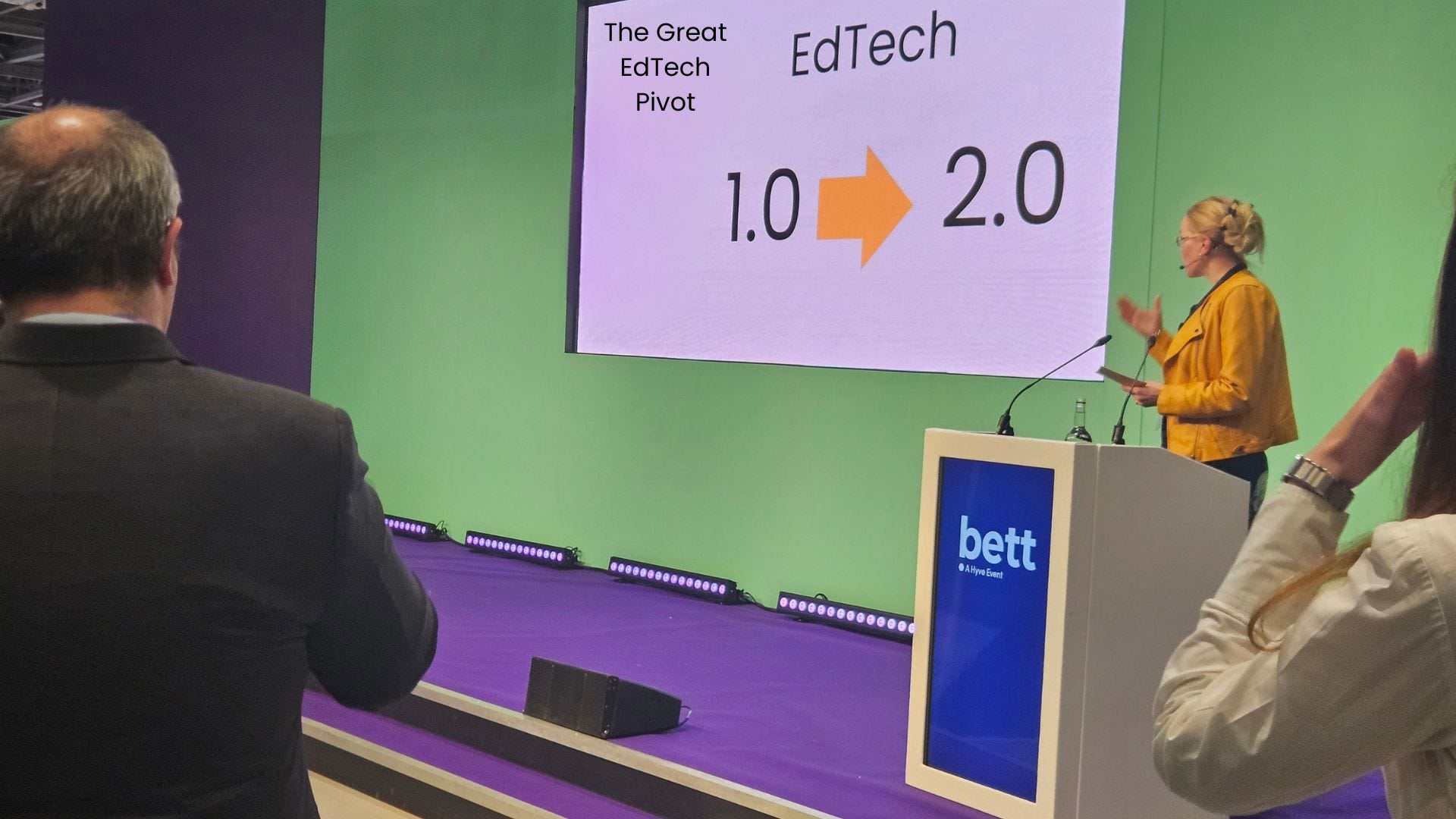
EdTech with impact by design is a fundamental shift in a sector that has been incentivised by reach and scale. It is a shift from the EdTech 1.0 era characterised by fragmentation, marketing-driven claims and thin evidence, to an EdTech 2.0 era defined by rigour, transparency, and genuine learning impact. In my BETT presentation, I emphasised that the questions we must ask of EdTech today are fundamentally different from those we asked in the first wave of EdTech 1.0: How do we design rigorous, standards-aligned evaluations that meet local requirements (such as ESSA in the United States) while also adhering to international research-council principles on ethics and open science? EdTech 1.0 largely sidestepped issues like data integrity, participant protection, or conflict-of-interest management. EdTech 2.0 requires understanding how tools actually function in real contexts, and supplementing experimental and quasi-experimental studies with deep qualitative research in classrooms and homes.
As one of the attendees commented, if this sounds unfamiliar and “too scientific” for marketing teams or investors, then you are in the wrong sector. This is the language you will increasingly hear in the months ahead, in Europe and far beyond: scrutiny of impact, commitment to research, and alignment with the science of learning.
And I am glad that, for the first time in a long while, BETT set a promising marker for EdTech innovation, shifting from hype to substance.

Final call for EdTech entrepreneurs: applications for the Milken-Penn GSE Education Business Plan Competition close next Wednesday, February 11, 2026. Semifinalists gain personalized mentorship through Catapult, Catalyst @ Penn GSE’s virtual accelerator, and access to a global network of education founders and investors—plus the chance to compete for up to $200k in cash and prizes.
Upcoming Events
We have a few events in the works, and more info coming soon! For now, save the date and RSVP if you plan to join us:
The Future of AI Tutoring: Building What Actually Works (Feb. 20)
What evidence says about effective AI tutoring—and how to design systems that deepen learning without replacing human connection.
The State of AI Adoption Across K-12, Higher Ed, and Government (Feb. 27)
A data-driven look at AI adoption across K-12, higher ed, and government in 2026, with insights from public-sector leaders.
AI & Efficacy: What Works, What Doesn’t, and What We Need to Know (Mar. 27)
How do we know if AI in education is actually working? Experts unpack evidence, gaps, and what efficacy should mean next.
Top Edtech Headlines
1. UNICEF launches new Digital Education Strategy
UNICEF has launched a new Digital Education Strategy (2025–2030) to use AI and digital tools to improve learning and support teachers worldwide. The focus is on equity, closing digital gaps, and helping countries build sustainable, people-centered education systems.
2. BETT 2026: The ten most-read stories from the biggest EdTech show of the year
The most-read BETT 2026 stories show edtech’s center of gravity has fully shifted to AI, with big moves from Google and Microsoft and lots of focus on real classroom use (not just hype). Other hot topics included inclusion and SEN, esports in higher ed, AI literacy, and hints that BETT is heading to the U.S. soon.
3. Carnegie Mellon, Gates Foundation fund AI-powered learning platform
Carnegie Mellon University and the Gates Foundation are putting $55 million into a new AI-powered learning platform called Learnvia to help students succeed in tough college courses with lessons, homework, and an AI tutor all in one place.
4. Schools in China are making AI part of the curriculum
Schools across China are now officially teaching AI as part of the regular curriculum, with kids learning basics like data and coding from around age 8 and more advanced concepts like algorithms by fifth grade to prepare them for a tech-centred future. It’s part of a national push to build AI skills early and boost competitiveness, even as some parents worry about age-appropriate exposure.

What EdTech Needs to Get Right About AI, Scale, and Learning Outcomes
We recently had John Gamba on The Edtech Insiders Podcast!
John Gamba is Entrepreneur in Residence at Catalyst @ Penn GSE, where he mentors education entrepreneurs and leads the Milken-Penn GSE Education Business Plan Competition. Over 17 years, the competition has awarded $2M to ventures that have gone on to raise more than $200M in follow-on funding, with a strong focus on equity and research-to-practice impact.
The 2026 Milken-Penn GSE Education Business Plan Competition is now open for applications. The application is simple and due by February 11. Apply here.
5 Things You’ll Learn in This Episode:
How the Milken-Penn GSE Competition supports high-impact edtech founders
Why research-to-practice is critical for scalable education innovation
How AI in education is moving from experimentation to institutional adoption
What it takes to center equity while building sustainable edtech businesses
Why learning outcomes matter more than funding or reach alone
 | A guest post by
|