


Get 10% off your EdTech Week Ticket with code EDTECHINSIDER10


How AI is Reshaping K-12 EdTech Procurement
By: Kira Warje
Kira Warje is a staff writer at the EdSignals Studio with a background in psychology, focused on the behavioral and systemic factors shaping how organizations navigate new technology. Her work explores the intersection of cognitive bias, structural pressures, and decision-making in the age of rapid institutional change.
The insights introduced in this article draw directly from six years of behavioral science research on K–12 procurement and adoption in the US by The EdSignals Studio, a capacity-building initiative of The Decision Lab (TDL). The Studio strengthens key US education market actors to accelerate the uptake of High-Quality Instructional Materials (HQIM) across core curricula, edtech, and curriculum-aligned professional learning. The Studio also delivers evidence-based actionable strategies to the ecosystem across four core pillars: research and experimentation, behavioral intervention and service design, organizational transformation, and ecosystem coherence built on collaboration and knowledge sharing.
EdTech procurement has always been challenging for districts: only 40% of EdTech purchasers agree that adoption is an easy, frictionless process.1 AI brings new complications to this strained procurement landscape, such as the risks of amplifying existing biases in evidence of EdTech quality and perpetuating student-voice gaps in purchasing decisions. However, it also offers real capabilities to improve procurement, including enhancing evidence accessibility and helping districts catch quality issues after products have been adopted. In this article, we explore how districts are factoring AI into their existing procurement journey and offer a roadmap for navigating product exploration, evaluation, and implementation in this shifting EdTech environment.
The Current State of Edtech Procurement in the Age of AI
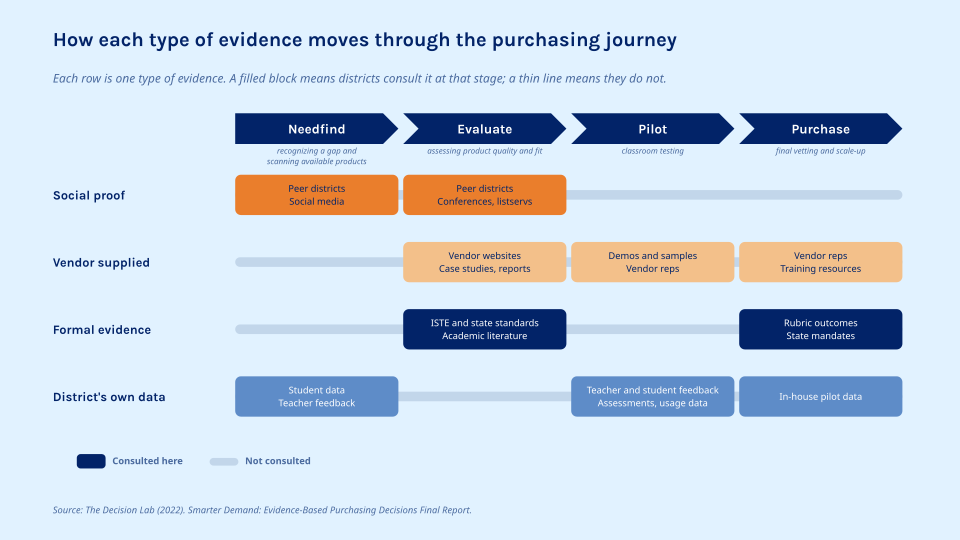
For district leaders, the EdTech procurement journey involves four key stages:
Needfind: Recognizing a gap and scanning available products
Evaluate: Assessing product quality and fit
Pilot: Classroom testing
Purchase: Final vetting and scale-up
District purchasers engage with evidence of product quality at each of these touch points, but the type of evidence they prioritize and how it’s used shifts at each step. Across the journey, behavioral barriers such as choice overload, sunk cost, zero-risk bias, groupthink, and ambiguity suppress engagement with high-quality evidence, further compounded by a market rife with mixed signals about what works.
With AI-enabled products emerging at an unprecedented pace, how are districts factoring AI-specific components into the purchase journey? Interviews with district leaders surfaced several de facto AI quality markers already in use, including:
Ethical-use frameworks
Containment features
Hallucination checks
Technical integration constraints
Switching-cost logic2
However, these markers are almost entirely focused on risk containment and operational fit rather than instructional efficacy.
Traditional, research-based quality markers can still apply when assessing whether an AI-enabled product teaches well. For example, alignment on what matters is one of the most important quality markers for districts evaluating new products.1 Among instructional leaders, these priorities include validation that a product improves student outcomes, alignment with effective digital pedagogy, security validation, and data privacy.3
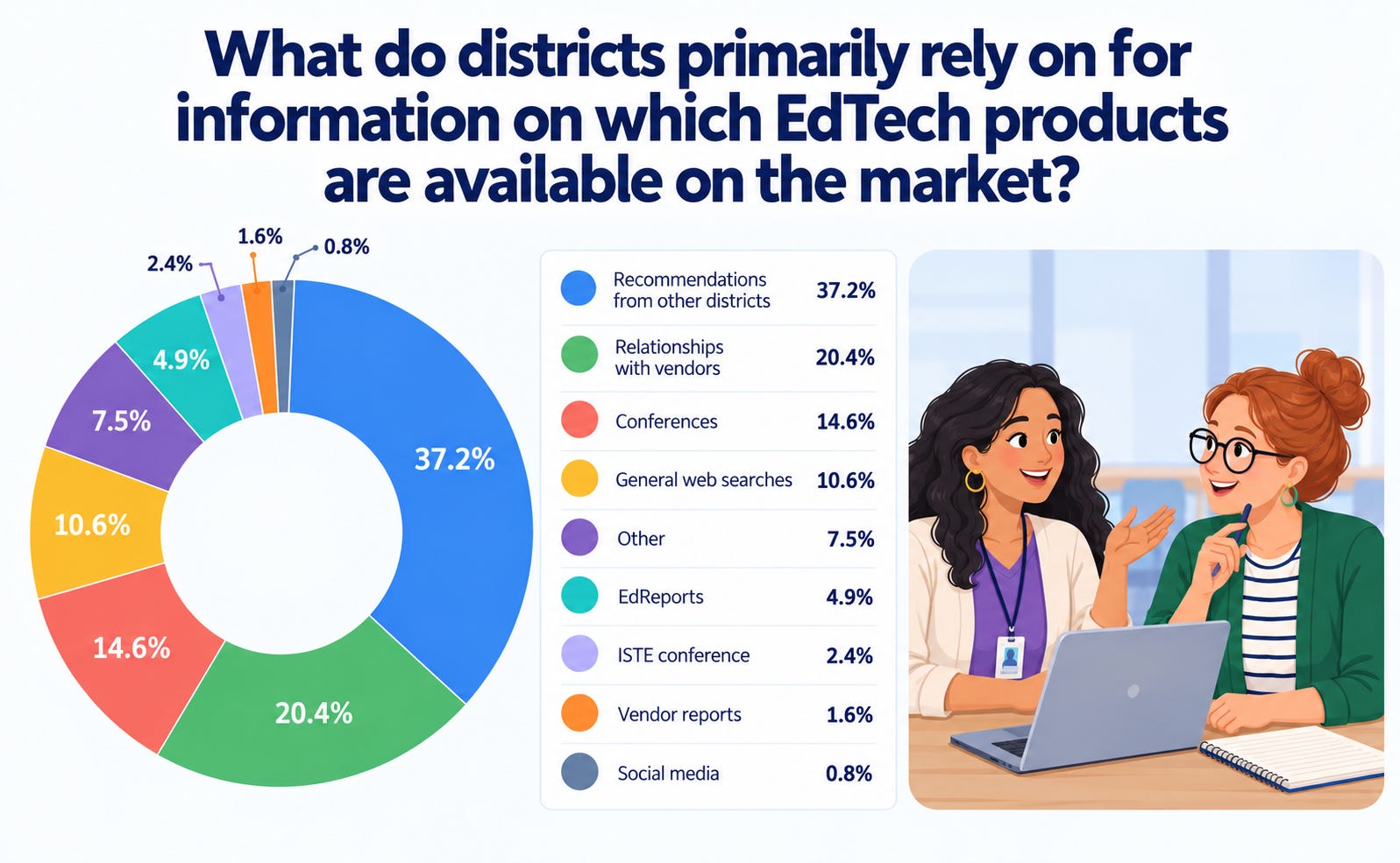
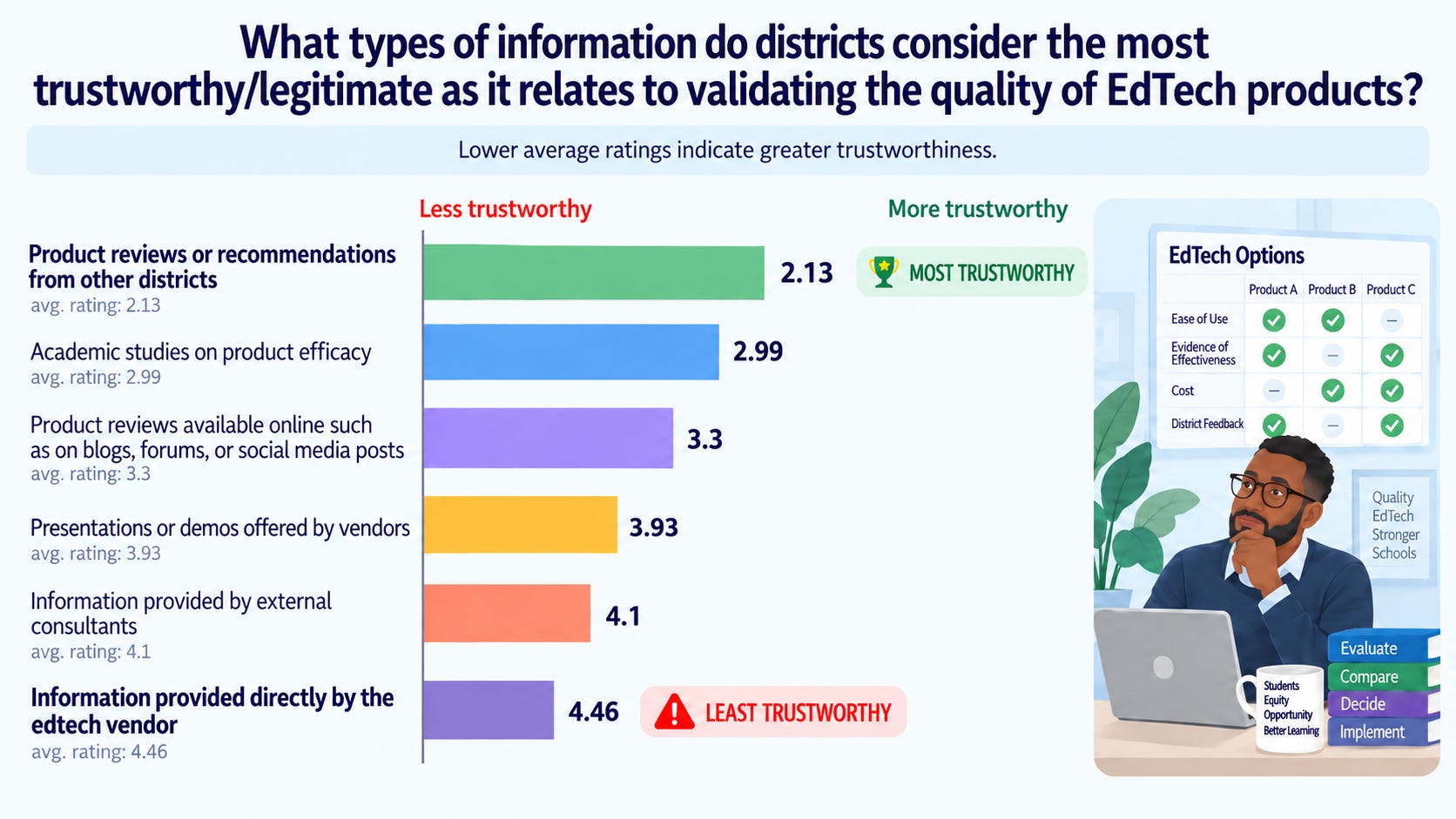
Yet, key barriers stand in the way of verifying those quality markers. While 65% of districts agree that there’s strong internal alignment on the most important evaluation criteria, only 40% formally establish those criteria before reviewing products.1 Exactly where districts seek information on product quality is another constraint. Peer recommendations are the most popular source of information on EdTech quality, with 94% of districts relying on them.2 In contrast, formal evidence intermediaries account for just 8% of market awareness. Likewise, vendor reports are the second-most consulted source of information on product quality, but they also rank as the least trustworthy. The procurement journey largely runs on social proof and internal data, while formal evidence enters too late to inform effective decisions.
The Role of Certifications in Evaluating AI-Enabled Edtech Products
Formal certifications could communicate some of these quality markers, but this avenue is rarely used by district purchasers. Roughly half the market is neutral about seeking out certified products, and two-thirds of these non-users cannot name a single certification program.4 There’s also an important structural gap to consider. Among 30 states analyzed for their AI education policies, 15 rely purely on voluntary guidance and just five have statute-linked law.2 This means that a district’s purchase friction is also geographical, with the majority of states lacking a regulatory quality floor.
In the absence of state-sanctioned standards, frameworks from organizations like ISTE, Digital Promise, and CAST might serve as the only quality assurance baseline available to districts.2 Yet, the proliferation of AI-enabled EdTech has introduced a flood of new quality frameworks into a market currently saturated with certifications, and too many certifications are already the top barrier to regular use among educational leaders.5 What districts need at this point is a clearer way to know which certifications to prioritize and when. For example, the ISTE Seal certifies whether a product has been tested for digital pedagogy and usability, Digital Promise certifications validate that a product’s design is backed by learning science, and the CAST Universal Design for Learning (UDL) product certification evaluates how strongly a product’s design supports equitable learning opportunities.
How AI Interfaces with Instructional Quality: Implementation and Delivery
Procurement establishes the choice architecture for how AI reaches the classroom, but procurement decisions don’t fully determine exactly how these products interface with instructional quality. Administrators, teachers, students, and vendors each experience that architecture differently.
From a position of oversight, AI helps district administrators spot patterns in data and screen for efficacy. Educational leaders often use AI to summarize or edit policy documents, draft communications, and analyze school data to identify areas for improvement.2 While these uses are beneficial, static procurement processes pose risks when AI models continue to update and evolve after purchase. Once a product survives piloting, it almost always gets purchased.1 Sunk-cost bias, in particular, makes it difficult to walk away from the time and effort invested in a pilot, so products are rarely re-evaluated.
While district leaders view AI as a rollout and adoption problem, teachers are the ones actually dealing with its behavioral and cognitive effects in the classroom.2 Additionally, 62% of teachers report that guidance on how to use AI in classrooms is nonexistent, vague, or unclear. Without that guidance, teachers are left improvising AI management themselves, with 83% reporting that this is their largest daily challenge.
There are two contrasting ways AI can be incorporated into instruction: short-circuiting the reasoning loop by giving students the answer, or lengthening it by eliciting critical thinking. The majority of teachers prioritize the latter, and 56% hold that AI must be either teacher-led or processed-focused.2 Yet, over half of students report using AI to brainstorm ideas and draft writing rather than genuinely engage with learning. It’s clear that teachers consistently struggle to direct effective use in the classroom: 32% report difficulties detecting AI use, 32% have trouble assessing whether students are actually learning from AI, and 24% face challenges designing tasks with clear AI usage boundaries. Many are also concerned that AI encourages isolated learning, with 34% naming a loss of peer learning as their top personalization concern.
Teachers also have psychological reasons to be hesitant about AI.2 On a personal level, teachers are concerned about losing their sense of professional agency, and AI is often viewed as a threat to their role and expertise. In terms of instructional efficacy, some teachers resist AI to protect the “productive struggle” that is core to learning. Many have also experienced AI hallucinations in the generation of lesson plans and learning materials, a weakness of the technology that degrades trust and encourages algorithmic aversion.
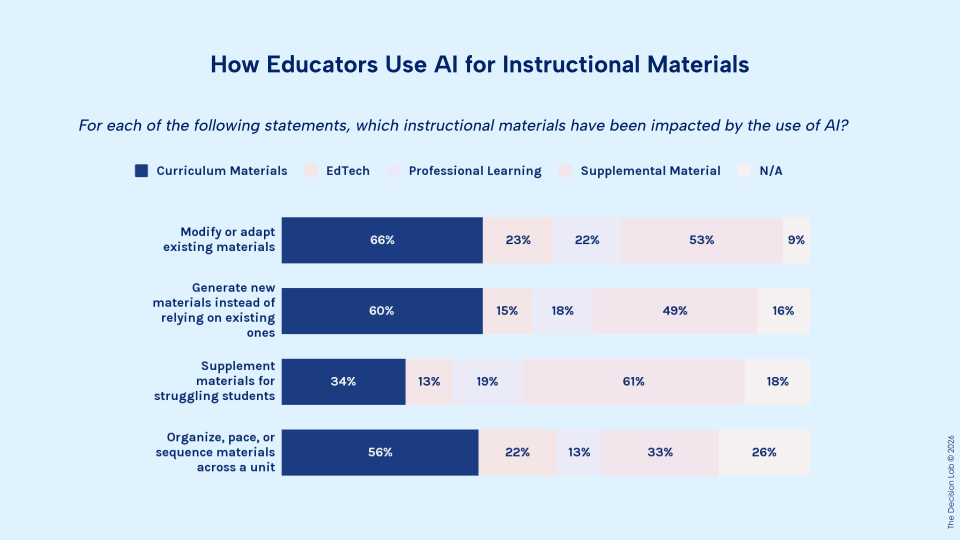
Despite this hesitation and lack of guidance, educators still use AI heavily, mostly to modify existing materials, generate new materials, and organize them across units.2 These functions break the fidelity assumption that the original material vetting process was built on; months-long procurement processes only validate materials as they are originally built, and no checks exist to ensure quality is preserved after core curriculum materials have been modified or supplemented with AI.
On the supply side, EdTech vendors prioritize product features that optimize usability and student engagement while accessibility and language acquisition are often sidelined, mirroring how districts rank their priorities when evaluating tools.1 In the process of aligning with district priorities, vendors’ greatest challenge is personalizing EdTech products to cater to diverse and evolving user needs and preferences. While vendors are motivated to design products around evidence of learning efficacy, 40% find this evidence difficult to access.1 Vendors also lack guidance on standards alignment: only 29% say they have enough information on how to actually meet a quality standard, a problem that only intensifies for smaller vendors. AI could prove instrumental in helping vendors overcome these challenges.
AI as a Double-Edged Procurement Tool
Beyond the classroom, districts are turning to AI to support the procurement process itself. For example, district leaders report using AI to draft more comprehensive requests for proposal (RFPs) and act as a thought partner for procurement research and strategic planning.2,6 These uses help resolve the most severe district capacity constraints; 54% of districts name academic efficacy studies as the hardest information to reach, with limited awareness and time being the top two access barriers. AI collapses these constraints by surfacing hard-to-reach evidence, synthetizing the results of multiple studies, and delivering insights in highly visual formats. Preferred by district decision-makers, these formats support the five main drivers of evidence use by making information easy to find (Available), frictionless to obtain (Accessible), presented with implementation in mind (Actionable), framed as useful and rewarding (Desirable), and grounded in real user outcomes (Pragmatic).1
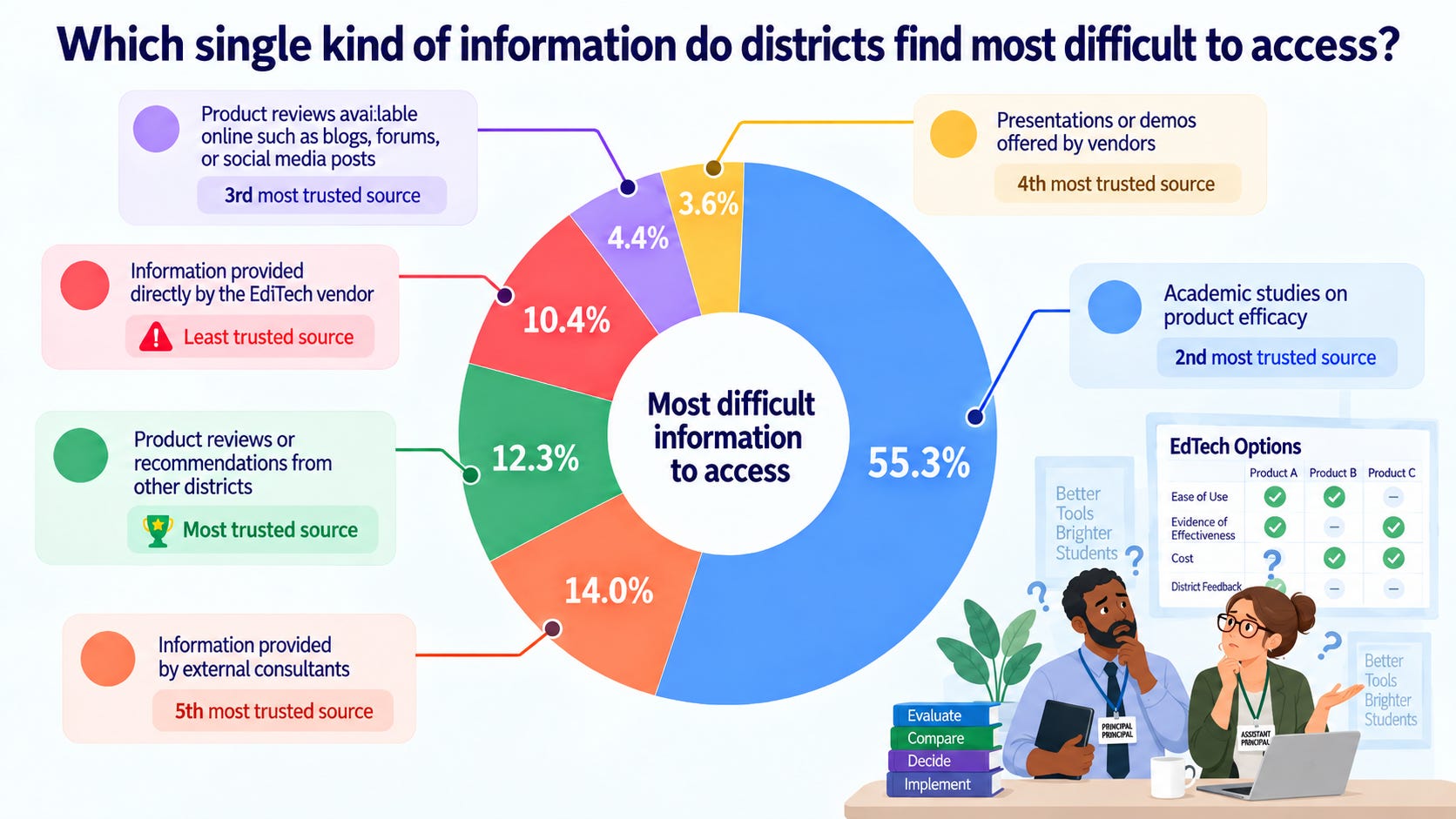
While AI is a promising procurement partner for dissolving district capacity challenges, it introduces a new risk: if a model is trained on evidence weighted toward self-reported vendor claims, its output will be biased toward those claims. Because districts are more likely to consult vendor reports than academic studies when searching for evidence of EdTech efficacy, bias is baked into the very evidence corpus districts already use.1 Moreover, AI-enabled summarization strips the provenance cues that district leaders use to discount marketing claims or vendor reports. AI summarization launders the evidence into a clean-looking summary, removing the important credibility signals districts rely on.
This isn’t the only area where AI inherits a bias that already exists. Among 259 district leaders in EdTech purchasing roles, only a quarter agreed that students are sufficiently engaged in EdTech selection, compared with 69% who say teachers are sufficiently engaged.1 Although districts rank student engagement as their top consideration when evaluating product features, student experiences are largely excluded from procurement decisions. AI summarization risks perpetuating this equity gap by validating products based on evidence that omits student voices.
Similarly, the process by which districts discover new EdTech suffers from structural inequalities. As it stands, rural and small districts have access to a smaller portion of the EdTech market due to cost, geography, and team capacity constraints. If AI procurement tools are built on the information districts have access to, those existing gaps will carry forward in the output.
A Stage-by-Stage Procurement Playbook for Strategic AI Use
AI doesn’t change the behavioral and systematic barriers districts face in the procurement process, but it does shift how existing gaps move through the adoption journey. Addressing this shift requires knowing when to bring in AI and when to lean on the frameworks districts already have access to. Districts should engage these resources at critical moments of the adoption cycle.
During exploration, when districts are dealing with capacity constraints that limit their access, awareness, and understanding of high-quality evidence, AI can help synthesize and translate dense evidence into digestible language. Meanwhile, existing frameworks like the ISTE Seal, Digital Promise certification, and CAST UDL allow districts to identify pre-vetted evidence of EdTech quality, ensuring AI summaries reflect formal research rather than biased vendor claims.
In the evaluation stage, AI can help district administrators mitigate cognitive biases by flagging potential blind spots and leading evidence-based exercises. For example, a pre-mortem analysis can help decision-makers curb groupthink and pilot valuation exercises can be valuable for avoiding the pitfalls of sunk cost.8
Following material selection, as districts implement and scale new EdTech, AI can assist with dynamic monitoring to ensure student engagement and instructional efficacy. This post-adoption monitoring process is the only way for districts to catch evolving AI-enabled products in real time. AI can also help resolve logistical challenges associated with student feedback collection and interpretation, allowing districts to engage student voices at scale.
Through these applications, AI can help districts move through procurement faster and more consistently, with fewer blind spots and biases that interfere with evidence use. Still, closing gaps in the purchase journey requires oversight regarding how AI is used for procurement and instruction to ensure the right sources of evidence, and the right voices, are reflected in the decisions it informs.
Building a Stronger Foundation for AI-Era Procurement
For those shaping the EdTech procurement system, the opportunity lies further upstream. While AI can genuinely help districts as they move through the procurement process, it also risks entrenching existing problems with evidence quality, transparency, and equity. Whether you’re building products or defining what high-quality EdTech actually looks like, foundational fixes stand to have a ripple effect that improve procurement outcomes: making formal evidence easier to access and trust, reducing certification clutter to clarify quality signals, building student voices directly into the EdTech evidence base, and establishing the guidance that teachers still lack. These fundamental solutions will shape whether AI truly closes gaps in EdTech or reinforces existing challenges.
Sources
Smart Demand: Integrating Buyer Insights into Signals for Solutions, 2024
Ecosystem Research #2
EdSignals Studio, Cohort #1, 2025
[DP Purchase Decisions]
[ISTE Shareout]
Ng, Alexandria. (2025, February 13). AI Is Beginning to Shape School District RFPs, and Companies’ Response to Them. EdWeek Market Brief. https://marketbrief.edweek.org/strategy-operations/ai-is-beginning-to-shape-school-district-rfps-and-companies-response-to-them/2025/02
Ecosystem Research #1
EdSignals Studio, Pilot Cohort, 2024
Thanks for reading! Support our work by becoming a paid subscriber, or email info@edtechinsiders.org to learn more about partnerships and sponsorships.
Insider Announcements
Hey Insiders! We’ve partnered with the team at StartEd to offer you all 10% off your ticket to EdTech Week 2026! We’ll be there, and we know many of you will be too.
This code is active for all ticket types. Grab your ticket now!
Upcoming Events

Funding Conviction: Edtech Capital, Founder Vision & the Room in October
Funding is back in EdTech, but it’s more selective. Join us for a conversation on Reach Capital’s new $265M fund, how higher ed and workforce learning are evolving, what it takes to hold conviction through changing cycles, and a first look at the StartEd CEO Summit this October. For CEOs weighing what comes next, from raising and scaling to partnerships and growth, start here.
Join us live or register to receive the recording the following Wednesday.
This is where the conversation starts. It continues at the StartEd CEO Summit, October 13–14 at Columbia University—a private, invitation-only gathering of EdTech CEOs, investors, strategic acquirers, and capital partners. Two days of candid dialogue, dealmaking, and deep thinking with peers, off the record and under the Chatham House Rule. Interested in joining the room? Request an invitation to the StartEd CEO Summit.
Be part of EDTECH WEEK 2026 in New York this October, where leaders across education, technology, investment, and AI come together to shape what’s next. Edtech Insiders community members can save 10% on registration with code EDTECHINSIDER10. Explore the 2026 agenda and register here.
More Upcoming Events
September 16 | LIVE | Los Angeles Edtech Happy Hour
Celebrate back-to-school with Edtech Insiders, Study Smart, Google, and Jacob Kantor (Chief DODO) at Public School 310 in Culver City.
Learn More & Register
September 22 | ONLINE | Building AI Worthy of the Classroom
Learn how developers can ground AI in trusted educational datasets, measure its quality, and build tools educators can trust.
Learn More & Register
September 25 | ONLINE | Building the Rulebook: Who Writes the Standards for AI in K-20
A conversation on the emerging product, policy, and investment questions shaping AI across education.
Learn More & Register

HigherEd Series: Can AI Help Higher Education Find Its Purpose Again?
Paul LeBlanc is the former president of Southern New Hampshire University, the largest non-profit provider of online higher education in the country. His new book, Reclaiming Purpose: The University in an AI World, examines how higher education can respond proactively to leverage the rise of artificial intelligence and reconnect to its essential task of helping students discover lives of purpose.
Hosted by Matthew Rascoff
This episode is part of the Edtech Insiders HigherEd Podcast Series, featuring conversations with leaders shaping the future of higher education.
5 Things You’ll Learn in This Episode
How AI could reshape higher education and work
Why human connection will remain central to learning
The evolving role of teachers in an AI-powered classroom
Why human-centered skills and the liberal arts may make a comeback
How universities can help shape a better AI future
Thanks for reading! Support our work by becoming a paid subscriber, or email info@edtechinsiders.org to learn more about partnerships and sponsorships.