


Get 10% of your EdTech Week Ticket now with code EDTECHINSIDER10

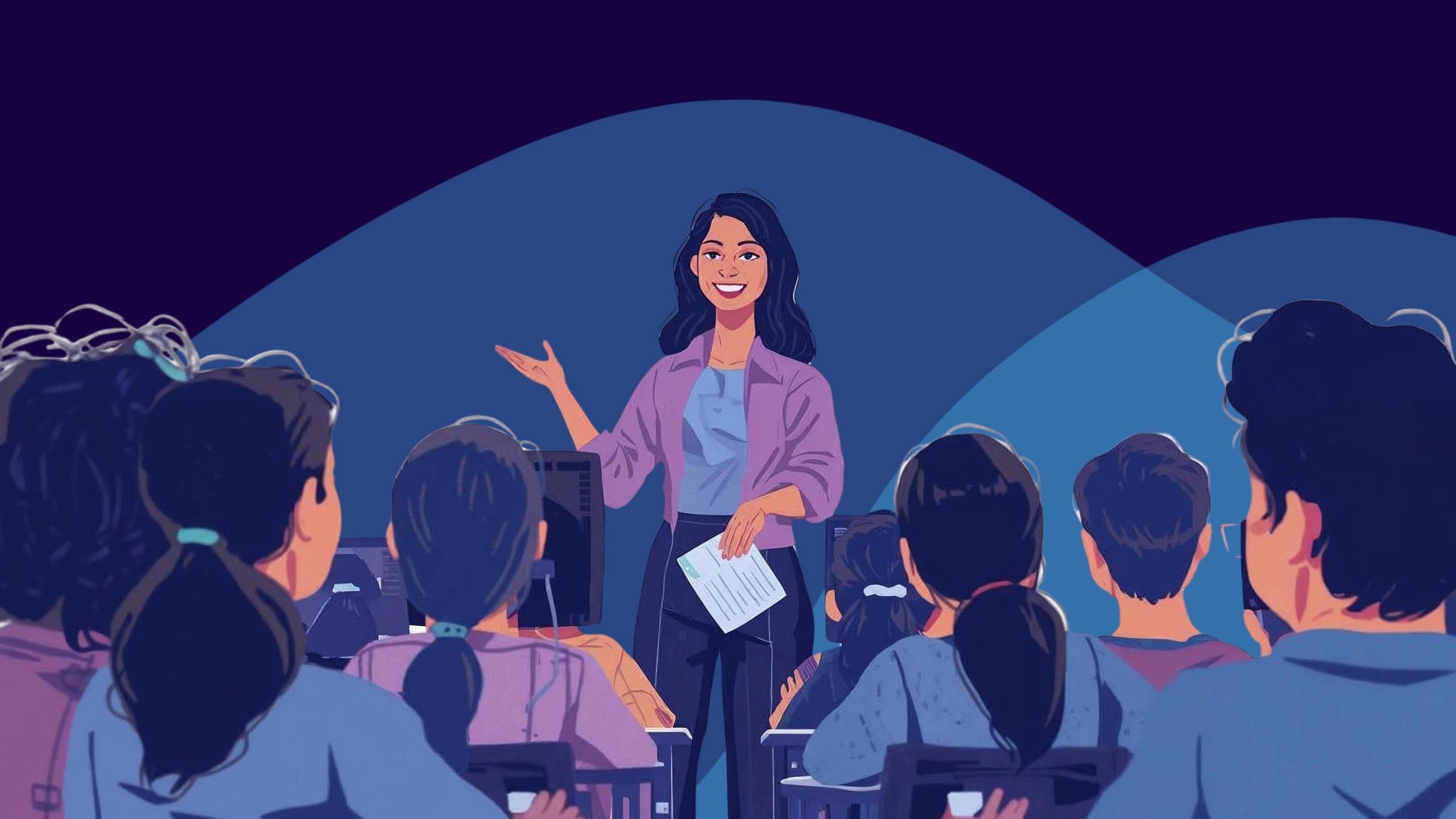
Google Classroom’s Approach to Educator-Led AI
Sponsored by Google
By: Brit Mennuti
Brit Mennuti is a Product Lead on Google for Education, where she looks after the team that develops and maintains Google Classroom.
I began my career in EdTech nearly a decade ago as a product manager on Google’s Augmented and Virtual Reality team. I was responsible for developing a tool that allowed teachers to take their classes on virtual reality field trips. Imagine a room of third graders all exploring the moon, or a high school class in an agricultural region of the US visiting historic Machu Picchu from their desks. I remember joining a real class in person for the first time to see the “field trips” in action, and my mind was blown— not just by how incredibly engaged the class was with the lesson, but by how our technology empowered the teacher to ground the student experience. While students felt like they were a part of the Milky Way Galaxy, their teacher was at the front of the room acting as a guide on their virtual tour, directing their attention to details and comprehension questions, and bringing them literally and figuratively back down to Earth. Both the teacher and the students were enamored with the tech because it actually accomplished what we were there to do: drive real student learning and engagement. It was at that moment that I knew I wanted to be in EdTech for the rest of my career—to have this profound impact on learning outcomes and empower educators with technology that is a force multiplier on the impact they already have today. And it was also at this moment that I learned the power of having the teacher in the lead, regardless of the technology.
Now, as the product lead for Google Classroom and a new mother, I find myself in a similar moment. There has been no shortage of AI tools released for educators and students, including from the product teams at Google. Many people ask me, “aren’t you worried about AI in education?” My answer always brings me back to those days working on virtual reality for schools. “Yes, I am worried, as any parent would be, but I know we will do it the right way as long as we empower educators to be in the driver’s seat.” With the rapid pace of change and the overwhelm that educators, schools, students, and families are feeling, this philosophy is more important than ever. Putting educators in the lead from design to implementation is critical to ensuring that the impact of AI in education is positive. At Google, we take this responsibility seriously. As we build AI features into Google Classroom and Workspace for Education more broadly, our approach stays centered on educators as the AI landscape continues to change and shift rapidly.
What does this mean in practice? It means tasking our best researchers with ensuring education use cases in our AI products truly shine. It means co-designing solutions alongside educators by getting regular feedback and iterating before our solutions go to market. It means vetting our ideas with experts, and holding ourselves to a very high bar for safety, bias, and quality when any AI experience goes in front of a student. It means running scientific research on our solutions with real classrooms globally to understand and measure their impact on learning outcomes. And it means giving educators and education leaders control over and visibility into the AI engagement of their students.
Our work on integrating Gemini’s Guided Learning mode into an educator-led experience inside Google Classroom is perhaps the best window into this collaborative, educator-first process of integrating AI tools into Google Classroom, and therefore classrooms around the world.
What is Guided Learning?
Guided Learning is an experience within Gemini that is designed to act as a supportive learning partner—think “encouraging the productive struggle of learning while helping you get to the answer,” rather than “giving you the answer.” The goal of Guided Learning is to encourage active participation, meeting students where they are by breaking down complex problems step-by-step and guiding them with probing, open-ended questions.
As an example, let’s say a student copies a homework problem into Gemini while in Guided Learning mode. Instead of solving the problem for the student, Gemini engages them in a conversation to break down the problem step by step until they learn how to solve it themselves and develop the metacognition to solve similar future problems on their own.
In June of this year, we announced that we are bringing this Guided Learning experience directly into Google Classroom for the upcoming Back to School season. This feature will be available this fall only for schools where administrators have enabled Gemini for their educators and students. Through this integration, educators will have the ability to assign a conversation in Gemini to their students that is locked into Guided Learning mode and grounded in their specified course materials, all while ensuring data is private and secure. Think of it as a learning support alongside their assigned work that is well versed in the student’s curriculum. As students engage with Gemini, their educators will get individual and class level insights into that engagement, including areas of strength and development, misconceptions, and access to direct chat transcripts for further detail in a secure environment. In this way we ensure the student experience with Gemini is one that encourages critical thinking, while the educator remains in the lead, not only when assigning the experience, but also after the fact as we equip them with rich insights to inform the next steps in their instruction.
Grounding in Learning Science and Measuring Impact in Real Classrooms
So what about our process of bringing Guided Learning to Classroom is particularly relevant and novel for this moment in technology? Well, it starts with learning science. Before developing Guided Learning, it was important to us, first and foremost, that the Gemini model itself was the best model for learning. Google DeepMind established a cross-disciplinary team of AI experts, neuroscientists, and cognitive scientists to answer questions like: How can we design an experience that prioritizes deep understanding and exploration of topics? How can we build experiences that honor the effort of learning while encouraging active understanding? With this group of experts we developed LearnLM, a version of the Gemini model trained specifically to behave in a pedagogical manner (i.e., encourage metacognition and stimulate curiosity). We then tested LearnLM against Gemini and other models in the market to evaluate how effectively the model exhibited pedagogical behavior. The result, after blind testing by experienced educators, was that LearnLM was the best option across all five learning science principles, leading us to merge the LearnLM model into all Gemini models starting in May 2025.
But proving the Gemini model was better at pedagogy was not where we stopped. Ultimately, we hold ourselves responsible for ensuring our tools developed on these models (like Guided Learning) lead to measurable learning impact. We recently partnered with Fab AI to conduct a pre-registered randomized controlled trial (RCT) with 1,763 students from junior secondary school (Grades 7 and 8) in Sierra Leone. The results demonstrate that students assigned to study with Gemini’s Guided Learning mode over the 8-week trial showed significantly improved learning outcomes, receiving a large boost—equivalent to moving a student from the 50th to the 59th percentile in mathematics. By standard conversion, that gain reflects roughly 1.2 to 1.7 years of extra learning progress in just 8 weeks.
“So the kids were struggling, but now, I’m seeing [...] half of the class or more than half of the class are able to solve problems on their own. On their own.”
- Teacher, Sierra Leone study
Most important to note here is that in this study educators were given license to incorporate Guided Learning how they saw fit. They were advised to incorporate Guided Learning mode into their curriculum but had full control over how and what they did, and the amount of time students spent with it. Educators were in the lead.
The Power of Keeping the Educator in the Lead
When we looked at the data from Sierra Leone, a clear pattern emerged: AI in education cannot be successful without deep classroom integration in partnership with the educator. While Guided Learning is a strong learning tool alone, its impact is unlocked when an educator is actively involved. We realized that integrating Guided Learning into Google Classroom could help educators provide personalized, 1:1 guidance to students at scale—something that many educators have told us they wish they could do, but that remained a hurdle with class sizes, resource constraints, and diverse student needs. By keeping educators in the lead, they can do what they do best: determine how to support their students, including enabling technology that is relevant, helpful, and grounded in their course materials. And most importantly, they will know when using Guided Learning that there is real scientific evidence to prove its impact on learning.
With this evidence in hand, we started our work bringing Guided Learning into Classroom by sharing early concepts and designs with real educators. They provided feedback on their expectations for such a feature, the levers of control they wanted to have, and the types of insights they’d need to effectively incorporate Guided Learning into their educational practice. We used that early feedback to shape what we built in close collaboration with the Gemini team and Google DeepMind. One of the key insights we learned through this process was that the socratic nature of Guided Learning had to be different in the school setting compared to the regular consumer context. We updated how Guided Learning works specifically in Classroom to ensure it met the socratic expectations of real educators. Once we had a prototype built, we started piloting it with real schools all over the globe, from the UK to Australia. In these pilots, educators have access to the feature in Classroom and can assign Guided Learning to their students. We regularly stay in touch with them and get their input on what is working and what needs to change. We are using this feedback to fine tune the experience before it is available for all schools this fall and will continue to iterate as we get feedback from educators. Our entire process has been educator-led from day one.
An Educator-Led AI Future
As I think back to my early days helping educators incorporate nascent technology into the classroom, I am reminded of the fact that the recipe for success for all student learning has always been to let educators call the shots. This approach is not new because of the “AI wave”—it has been our mode of operation since Google started building technology for schools 20 years ago (when we quite literally traveled on a school bus from school to school understanding educator needs to inform what we built). By bringing Workspace, like Google Docs, into Classroom in ways that amplified educator impact, rather than taking away from it, we freed up educators to do what they do best. And now we are applying this same playbook to how we safely and responsibly build AI for schools.
As the mother to a one-and-a-half-year-old, I think daily about what my daughter’s future will be like. It is not lost on me that my influence, and the influence of the incredibly talented team of Googlers around me, will have a direct impact on how she learns. And that is a serious responsibility! But it is the community of educators we have the privilege of working with daily that gives me hope for her future, and the future of children all over the globe. While lately conversations about the future focus on technology, I look forward to keeping the conversation firmly focused on the people at the forefront of leveraging that technology for their students.
Thanks for reading! Support our work by becoming a paid subscriber, or email info@edtechinsiders.org to learn more about partnerships and sponsorships.
Insider Announcements
Hey Insiders! We’ve partnered with the team at StartEd to offer you all 10% off your ticket to EdTech Week 2026! We’ll be there, and we know many of you will be too.
This code is active for all ticket types, including 10% off the already discounted early bird pricing through August 31. Grab your ticket now before the price goes up!
Upcoming Events

What Is the Future of Higher Education in America?
Sponsored by Masterclass and Studiosity
Friday, August 28
9:00-10:00 AM PT / Noon-1:00 PM ET
Webinar on Zoom
AI is reshaping learning, employers are rethinking credentials, and universities are facing unprecedented change. Join us for a live conversation with an incredible panel of experts exploring how higher education must evolve to remain relevant, accessible, and valuable in the decade ahead.
Join us live or register to receive the recording the following Wednesday.
Top Edtech Headlines
1. Bringing ChatGPT for Teachers to more U.S. school districts
OpenAI is expanding ChatGPT for Teachers to 55 additional school systems across 20 states, bringing the program to more than 300,000 educators and staff across 100+ K–12 organizations. The expansion includes free access through June 2028, new privacy agreements covering 16 states, and hands-on training for educators and district leaders, as OpenAI positions teacher-led implementation, data privacy, and responsible adoption as central to bringing AI into schools at scale.
2. Harvard Is Selling a $699 Course Taught by A.I. Clones of Its Faculty
Harvard Business School is using AI-generated video avatars of its professors to teach a new $699 entrepreneurship bootcamp. The experiment raises broader questions for higher education about whether AI avatars can extend the reach of expert instructors, what students are actually paying for when they enroll in courses, and how universities will balance AI-generated instruction with the value of human faculty.
3. Meta to Pay Up to $17.1 Billion in Landmark Settlement Over Social Media Addiction Claims
Meta has agreed to pay up to $17.1 billion and make sweeping changes to how children and teens use Facebook and Instagram as part of a landmark settlement with states over allegations that the platforms were designed to addict young users. The agreement includes daily time limits, nighttime blocks, stronger age-assurance measures, and other protections for minors, marking a major development in the growing push to hold social media companies accountable for their impact on young people.
4. Report: MIT’s Ad Hoc Committee on AI Use in Teaching, Learning, and Research Training
MIT’s new report is a cumulative look at how they are thinking about and approaching AI within their Institute, and a great case study for how AI is impacting Higher Ed and what needs to be done to move forward with intention and efficacy.
Learn more here.

Why Edtech Needs Less Hype and More Honesty with Tony Wan & Betsy Corcoran
Tony Wan is Head of Platform at Reach Capital and co-founder and former managing editor of EdSurge. Betsy Corcoran is a writer, speaker, serial entrepreneur, and co-founder of EdSurge who explores AI and learning through her work and podcast, Future Fluent.
5 Things You’ll Learn in This Episode
How EdSurge helped shape the early edtech ecosystem.
Why edtech needs more honest and nuanced storytelling.
What the tech backlash gets right and where it misses the bigger picture.
Why teacher-turned-founders and school leaders are critical voices in edtech.
How AI can support education without becoming the focus itself.
Thanks for reading! Support our work by becoming a paid subscriber, or email info@edtechinsiders.org to learn more about partnerships and sponsorships.
Why is Google going to turn off search entirely for schools which decline to allow it's AI? So much for educator-led learning.
Nice to get an inside look into how the Google Classroom team are approaching teaching & learning and AI.