


Get 10% off your EdTech Week Ticket with code EDTECHINSIDER10


5 Takeaways From Microsoft’s Global AI in Education Survey
At the end of 2025, Edtech Insiders predicted that by the end of 2026, just about every teacher and student would be using AI, either through AI-native tools or AI features. It seems we’re getting closer, according to Microsoft’s new AI in Education: A Microsoft Special Report, which surveyed 3,345 people across the U.S., U.K., Australia, Brazil, Japan, and Saudi Arabia in February and March of this year.
In this new report, Microsoft laid out five principles for how it thinks about AI in education: protecting student safety and privacy, keeping educators in control, making sure AI supports rather than replaces student thinking, strengthening education systems, and preparing every student for an AI-powered future. Those principles provide a useful framework for understanding findings in the data that may initially appear at odds with one another.
Let’s start with one of the least surprising findings in the report…
92% of students
88% of educators
92% of education leaders
… have used AI for a school-related purpose at least once or twice, and
27% of students
33% of educators
53% of education leaders
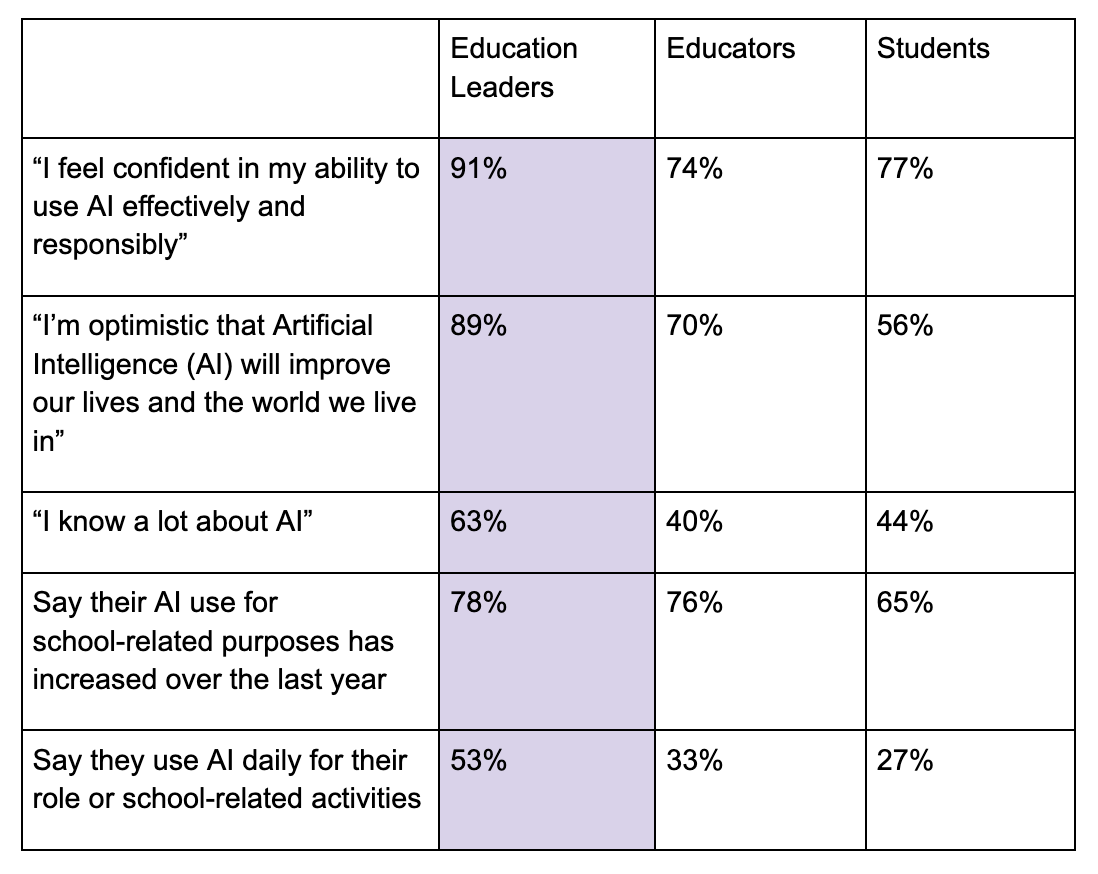
…are using it daily in their role or for school-related activities.
A recent Britebound study earlier this month, per Edtech Innovation Hub, found similar usage results: “83% of students in grades 7-12 use AI tools, with around two-thirds of users turning to them at least a few times a week and 30% using them every day.” In other words, a third are using AI daily, twice that many are using it 2-3 times a week.
While it may not be news that AI usage continues to rise, this new Microsoft report surfaces several findings that add nuance to our understanding of AI adoption at this pivotal moment. Here’s what caught our eye:
1. Education Leaders are Bullish on AI
Education leaders had more positive responses to virtually every question than other audiences surveyed in this report:
Why it Matters
This was the most surprising result of all to me… after all, aren’t we in a moment of “techlash”, where education leaders are supposed to be turning their backs on Edtech, screen time, and AI? Didn’t we just see the biggest district in the U.S. put a one-year moratorium on AI usage?
Global disparities surely explain parts of these results. After all, if you are in a country that has just instituted a major AI initiative from the government, added AI to your national curriculum, and is actively touting it as the future of work, you may be more likely both to use AI yourself and to feel positively about its impact.
Maybe education leaders, not spending every day in the classroom, have a relationship to AI that looks a lot more like that of other professional knowledge workers; they use it more and more, and believe that it’s going to be more and more a part of working life in the future. Meanwhile, educators and students are still caught in the whirling schema of rapidly changing tools, slow institutional change, and unclear guidelines for implementation and usage.
None of this means that education leaders are wrong to be bullish… but moving from individual usage experimentation to institution-wide adoption and comfort brings a completely different set of questions around governance, security, data, training, infrastructure and which problems AI is actually supposed to solve.
That’s where one of Microsoft’s stated principles in this report—that AI should strengthen education systems, rather than simply add another layer of technology to them—feels relevant. Education has a long history of buying technology first and figuring out the implementation model afterward. If leaders are going to be the most aggressive advocates for AI inside their institutions, the bar probably has to be higher this time
2. Despite Skepticism, Everyone Thinks Learning AI Skills Is Very Important
Across all countries and audiences, the need to know how to use AI “effectively and responsibly” is considered a must-have for students’ futures, according to most respondents.
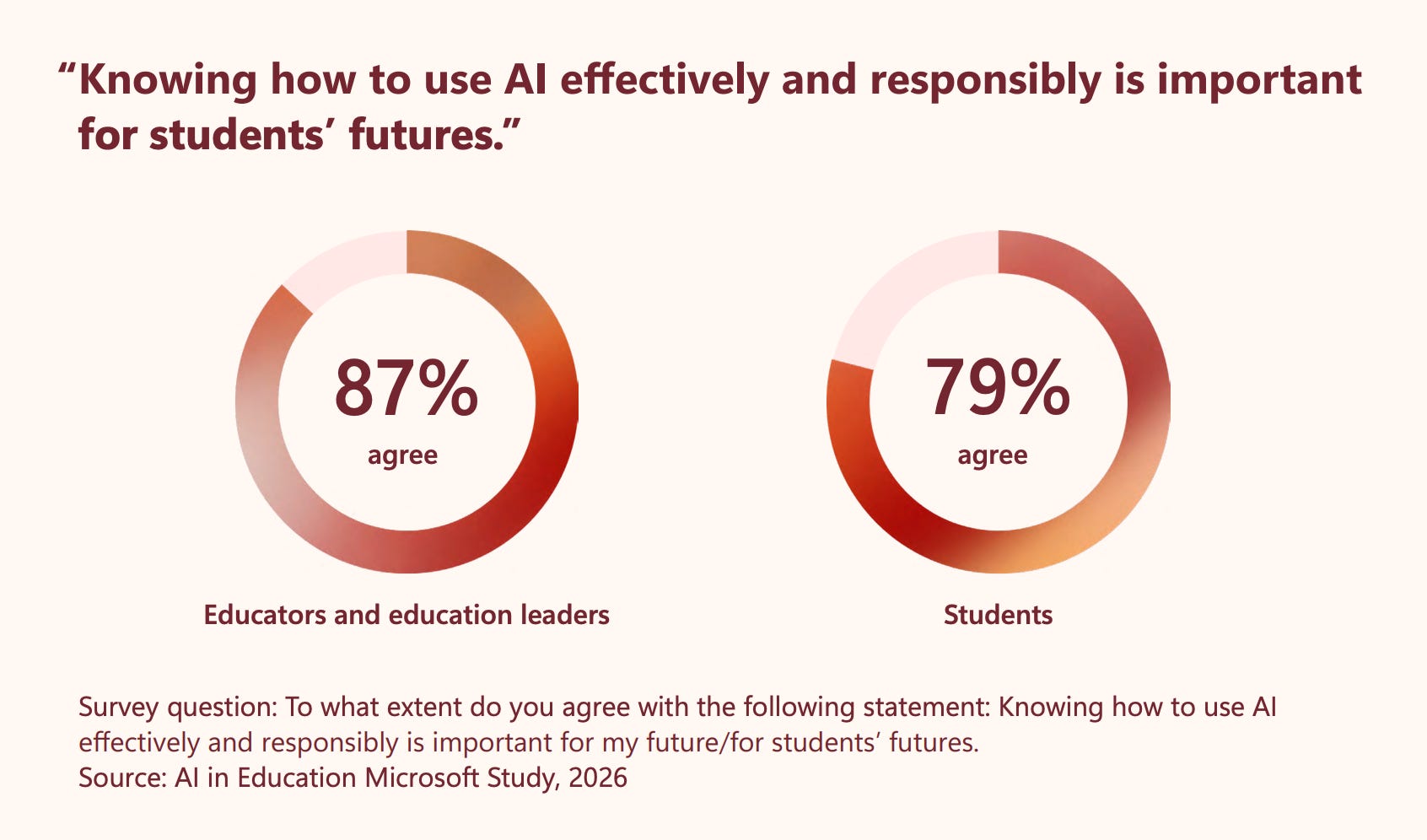
So students who are wary of AI’s impact on their lives and the world are also holding strong feelings that they need to interact with and learn about AI. And, from a purely career-oriented perspective, there is material that aligns with this perspective:
LinkedIn projects that about 70% of skills used in most jobs will change by 2030 (link)
The share of jobs listing AI literacy as a requirement went up sixfold in a single year (link)
Why it Matters
Despite strongly held perspectives on the importance of AI for student’s’ futures, fewer than half of educators call AI literacy “an essential component of basic education for every student.” Teachers, leaders and students all say they need AI skills, but educators aren’t sure it belongs in the core curriculum.
I suspect that many educators already have their plates full teaching the existing core subjects and the idea of teaching a brand new, not-yet-defined curriculum that they themselves (and just about everyone else) are just beginning to understand may not be the most appealing prospect. Change is hard in education, but for my money, this is the same reason why CTE, computer science and other relevant subjects have gotten much more lip service than actual implementation over the years.
This is also where the definition of “AI literacy” becomes really important. This also gets directly at another of Microsoft’s principles in this report: preparing every student for an AI-powered future. The Microsoft report argues that AI literacy shouldn’t mean simply knowing how to write a good prompt, or even knowing how to use whatever AI products happen to dominate today. It includes a deeper understanding of what AI can and can’t do, the ability to evaluate its outputs critically, addressing ethical implications, exercising judgment, and, of course knowing when not to use AI.
I think that’s a much more useful way to frame this problem. The AI tools students use in 2035 will almost certainly look very different from the ones they use today, so teaching a generation of students to become extremely proficient users isn’t really the point. Teaching them how to work thoughtfully with increasingly capable machines, while maintaining skepticism, judgment and agency, might actually deserve to become part of what we mean by being an educated person.
Microsoft is already experimenting with versions of this approach for learners at different ages; for younger learners, its Minecraft Education AI Ready Skills program teaches foundational AI concepts through a game-based curriculum rather than simply handing children a chatbot. The details of these curricula will undoubtedly keep changing, but the larger idea feels valuable: AI literacy probably needs to become less about using AI tools and more about understanding how to live, learn and eventually work in a world full of them.
3. AI Optimism Isn’t Universal – It’s Contextual
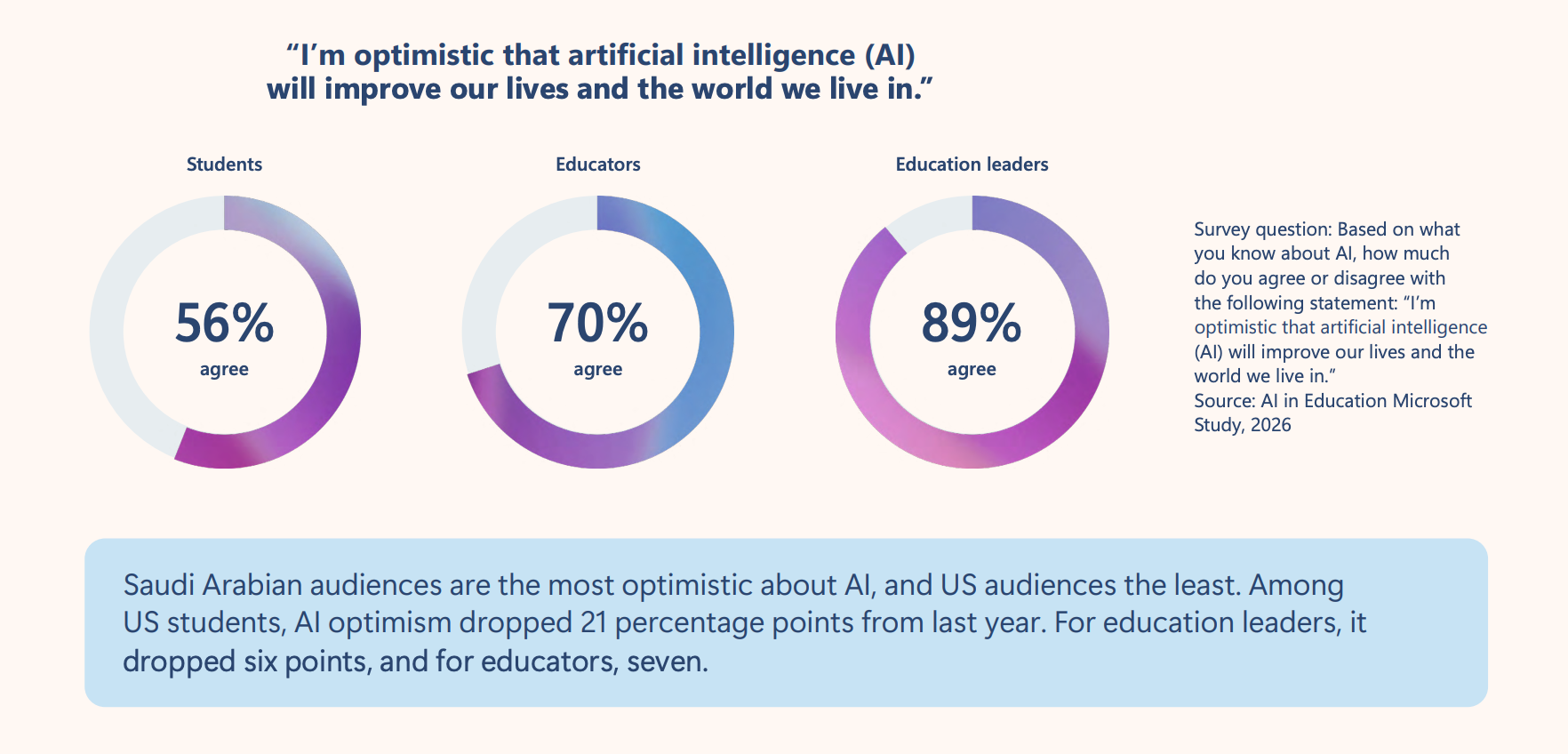
This report names U.S. audiences (students, teachers, and leaders) as the least optimistic in the sample, with Saudi Arabian audiences being the most optimistic. Moreover, U.S. student optimism fell 21 percentage points in one year, indicating that the concerns around AI may be hitting students even harder than it does adults. Optimism among education leaders and educators dropped too, by six and seven points.
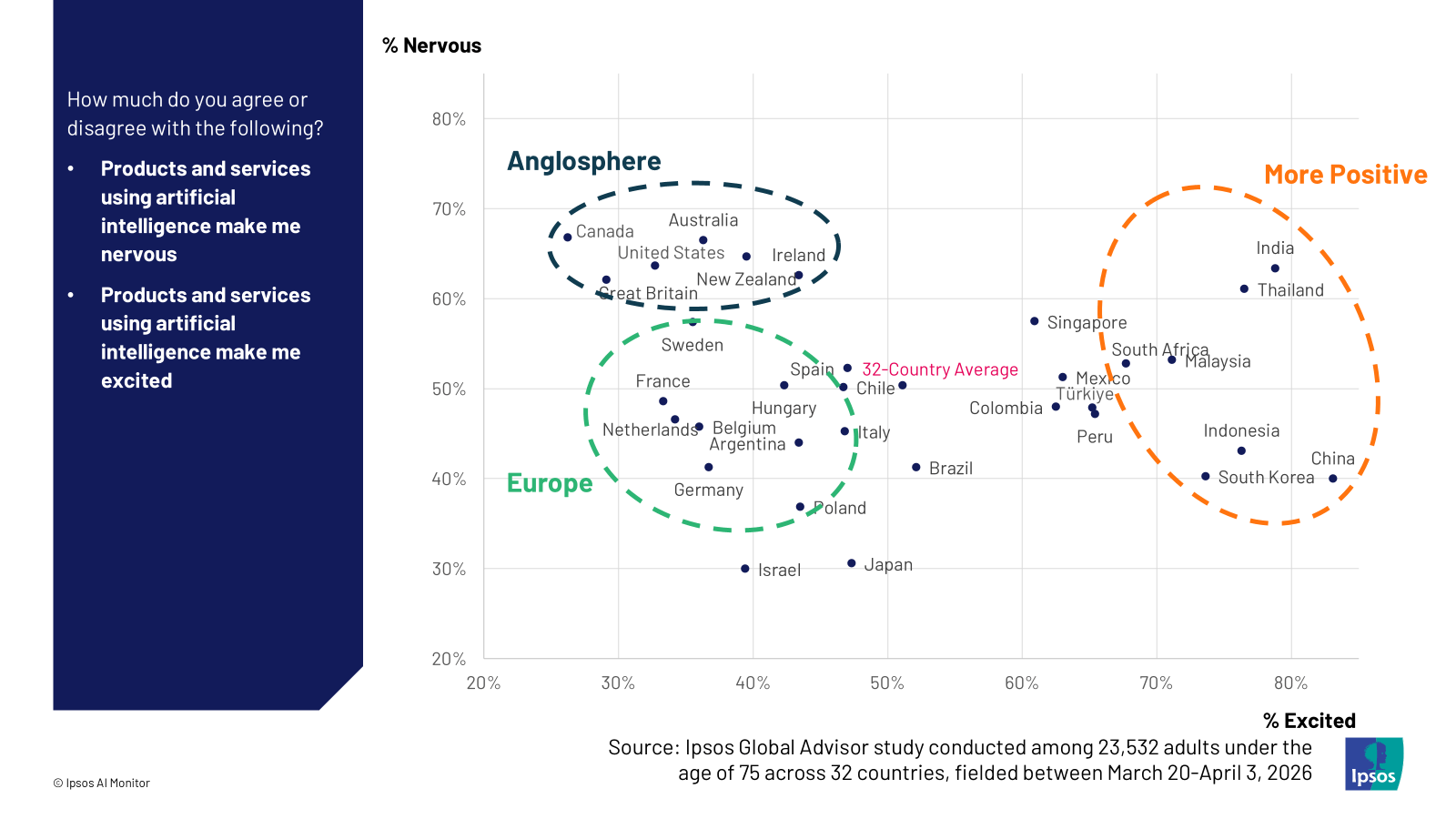
A recent Ipsos report adds context to the global divide, even outside of the educational context: the “Anglosphere” tends to report much more nervousness than excitement about AI, the developing world far more excitement than nervousness, and Europeans, along with Brazil, Israel and Japan, relatively low on both counts.
Why it Matters
Most importantly, there’s a trust question hiding underneath all of this. Microsoft puts safety, privacy, security and transparency first among its five principles for AI in education, and the enormous differences between countries suggest that trust in AI isn’t being formed by technology alone. It is contextualized by what governments say about it, what schools teach about it, what teachers model, what students hear in the media and, perhaps most importantly, what students actually experience when they use it.
There are many ways to interpret this enthusiasm gap in AI, all of them interesting in their own way:
Press coverage: One study of global press coverage of AI showed that “Global North newspapers such as The Guardian and The NYT framed AI negatively in… news headlines, while the Global South newspapers such as China Daily and Bangkok Post framed AI positively in… their news headlines.” (Note that this review only went until 2023, just before the major Gen AI boom).
Government Enthusiasm: Many developing countries see AI as a chance to turbocharge their economic development, and have been unremittingly positive about it publicly; for example, in South Asian countries like Thailand, Malaysia and Indonesia, governments are actively pushing for wider AI adoption, through programs like ThAI Passport, AI Malaysia Berhad or Indonesia’s National AI Strategy. Saudi Arabia, whose students were the most optimistic about AI, just announced the “Year of AI”.
Curriculum Integration: For similar reasons, many developing countries are rapidly integrating AI into their national curricula; China has famously integrated AI into schools for learners as young as third grade. Saudi Arabia has introduced a mandatory National AI Curricula: “one of the world’s first comprehensive national AI curricula — spanning elementary school through university level for the 2025-2026 academic year, reaching six million students across the Kingdom’s public school system.” (source) In April Brazil’s Ministry of Education published its National AI framework for Education.
For students, it’s likely that the last point is the most salient for your life… if the experience below was your first exposure to AI, you’d probably feel optimistic as well:
“In an elementary school classroom in Beijing’s university district, 11-year-old Li Zichen was demonstrating a small robot. It’s a remote-controlled vehicle that lifts and moves blocks and that can be programmed using artificial intelligence. It’s a small project, but it got him thinking big—about the rovers that China sent to Mars and the Moon.
“If a rover comes across a crater in front of it, for instance, it can’t decide what to do after communicating with Earth,” he says, because sending signals across space takes too long. “It must decide on its own. So I think AI is very important for the nation’s deep space exploration.”
- “In China, AI is no longer optional for some kids. It’s part of the curriculum,” NPR
4. Students and Teachers Are Worried About the Same Thing, From Opposite Sides
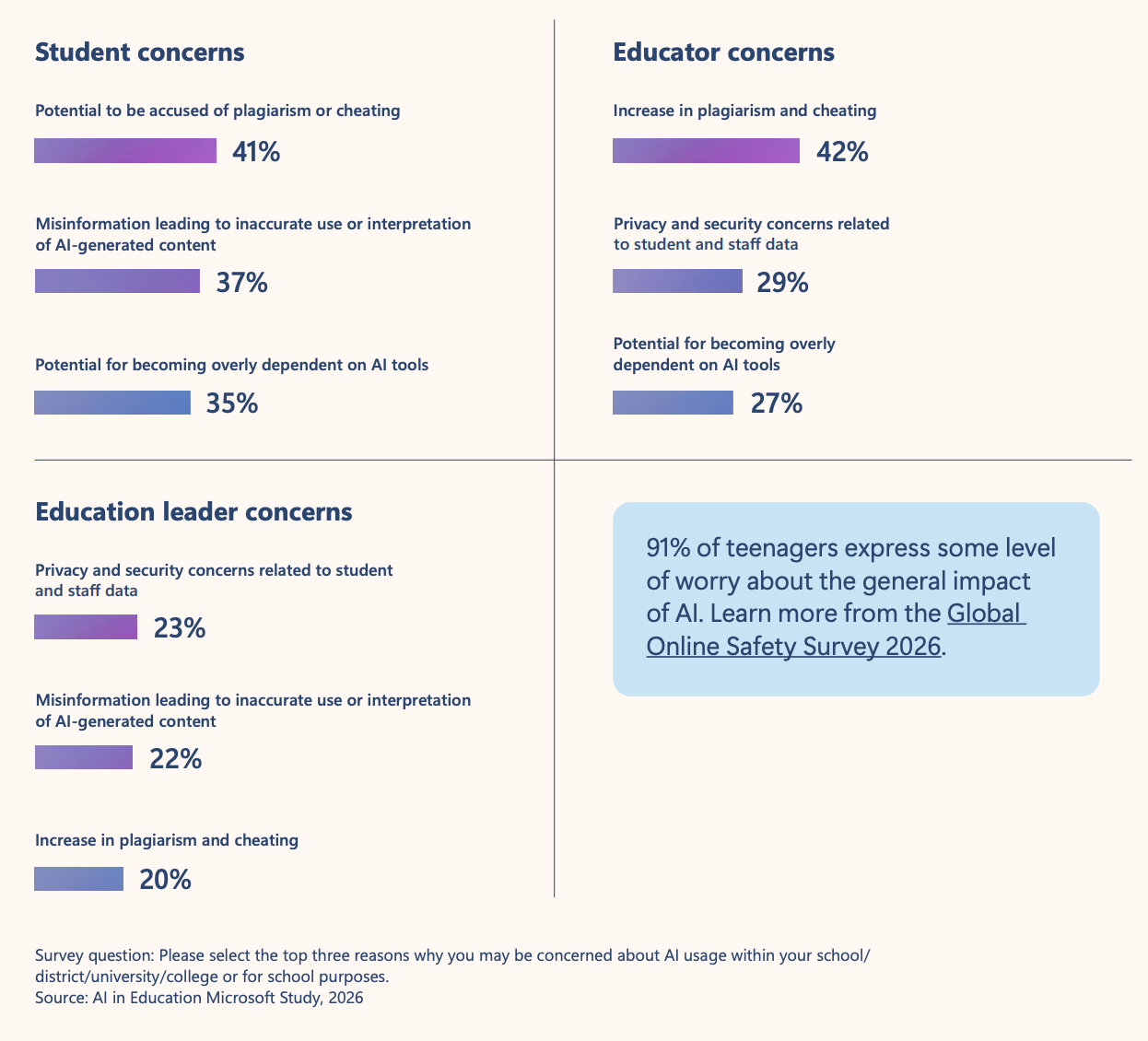
For both educators and students, plagiarism is the top concern noted around AI in education:
Educators: 42% put an increase in plagiarism and cheating in their top three concerns
Students: 41% put getting accused of plagiarism or cheating in their top three
One side is afraid of cheating... and the other is afraid of getting blamed for it.
Education leaders had a different result; only 20% listed cheating as their top concern, about half the rate of educators. Their top concern instead is student and staff data privacy and security (23%). That tracks, since they’re the ones deciding which tools come into classrooms. But, it also means the people writing policy and the people enforcing it aren’t worried about the same stuff, and that the educators and students eyeing each other warily might not be getting the support they need to navigate this tough moment in AI adoption.
Why it Matters
Microsoft calls out that the bigger problem for AI in education looks like a “guidance gap”, in which education leaders feel like guidance is in place, but educators and students don’t. The integrity issue is the frontline of that gap; if educators and students don’t feel like they understand the policy on integrity and/or can’t implement it, they are left adrift in a low-trust environment:
Four-fifths of education leaders say their institution’s AI guidance is clear, while half of students and teachers say it’s neutral or not provided.
77% of students and 53% of educators say they’ve had no AI training, while seven in ten leaders think at least half their users have been trained
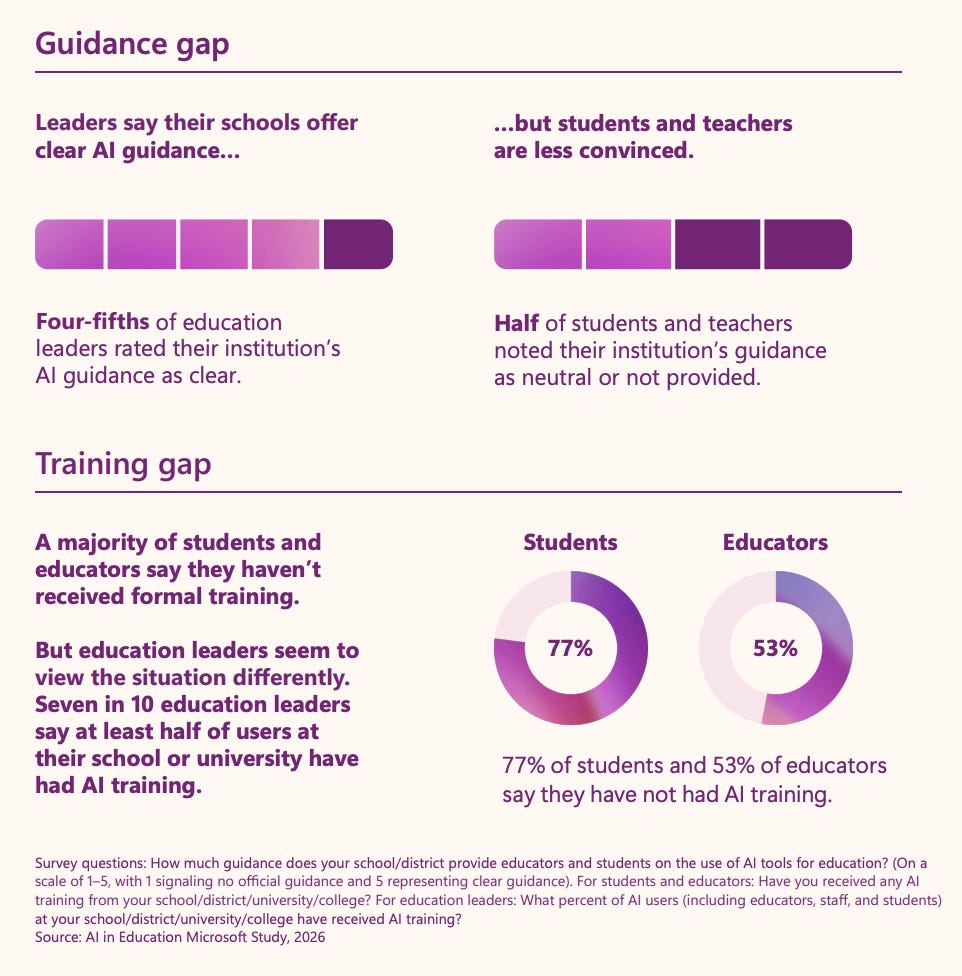
Students are asking for rules, not loopholes. Responsible use and plagiarism education is their second most requested form of support. Educators’ top task is AI literacy training, then clear guidelines. The report highlights Mid-Pacific Institute in Hawaii as an example, where high school students help write the school’s AI policies—see our recent article on the rise of AI councils for more on this concept.
This is also where Microsoft’s principle of keeping educators “in control” gets much more concrete. Being in control of AI doesn’t just mean giving teachers an on/off switch. Teachers need to understand what the tools can do, what students are doing with them, what their institution’s rules actually mean in practice, and what to do when inevitably messy situations arise.
And right now, the data from this report (and others) suggests that a lot of educators simply don’t feel equipped for that. Microsoft is addressing that through programs like Microsoft Elevate for Educators, which provides training, credentials, resources and communities of practice around AI; other frontier labs also offer extensive training and resources for educators. But the larger point applies well beyond Microsoft: we cannot simultaneously tell teachers that they’re responsible for determining appropriate AI use and then leave them largely on their own to figure out what “appropriate” means. The guidance gap isn’t a side issue in AI adoption; it may be one of the central ones.
5. Students Use AI Often – But View It Cautiously
Of all the users surveyed in this report, students were actually the least optimistic about AI’s potential to improve their lives.
Why it Matters
To me, this was a real surprise. Young people are a demographic that are often both early adopters and historically excited about new technology.
Microsoft’s report hypothesizes that:
Students see AI improving fast while the job market feels shaky
Their schools’ guidance hasn’t kept up
The more they use it, the more they notice what it can’t do
These reasons resonate, but I suspect there’s another reason for this student pessimism as well. For many students, AI has been portrayed by both their teachers and their peers as simply a way to cheat on homework, which puts students in a self-imagined position to be either “pro-AI” (cheaters) or “anti-AI” (non-cheaters).
To wit: many of the most interesting use cases of AI for users of all ages are simply never modeled or explained to students, and the effect of AI on the working world is opaque to everyone, let alone students who have never encountered it.
This also gets at one of Microsoft’s core principles for AI in education: AI should support student learning, rather than replace student thinking. There is a very real risk that if a student’s primary experience with AI is “ask it a question, get an answer, paste it into an assignment,” they may simultaneously use AI all the time and have very little sense of why it is actually good for their learning. Microsoft specifically calls out the risk of “cognitive offloading”—creating the appearance of learning while quietly moving the actual thinking from the student to the machine.
If we want students to feel positively about AI in education, simply giving them access probably isn’t enough. They need to experience versions of AI that help them think, explore, create and get unstuck without doing all of the intellectual work for them, and educators need to remain at the center of designing those experiences.
Conclusion
As always in technology, with great power comes great responsibility. Getting to the heart of how AI is truly landing in classrooms around the world, and how to ensure that its impact on education is positive, is one of the most complex problems of our age.
To me, that’s what makes the findings in this report so interesting. They add some of the nuance we desperately need right now, and don’t point toward a simple “AI is good for education” or “AI is bad for education” conclusion. They shed light on an education system that has adopted AI remarkably quickly without yet reaching anything close to a consensus about how it should actually be used.
And Microsoft’s five principles map closely onto the tensions in its own data. Students need AI experiences that strengthen their thinking rather than replace it. Teachers need training, guidance and real control over what happens in their classrooms. Schools need safety, privacy and governance structures that create trust. Institutions need to think beyond isolated experiments toward coherent implementation. And students need an understanding of AI that prepares them not merely to use today’s tools, but to navigate whatever comes next.
The big question for education, in other words, is probably no longer whether AI is coming. According to Microsoft’s own numbers, it’s already here. The much harder question is whether schools can become intentional enough, quickly enough, to shape what kind of relationship students ultimately have with it.
Thanks for reading! Support our work by becoming a paid subscriber, or email info@edtechinsiders.org to learn more about partnerships and sponsorships.
Top Edtech Headlines
1. Articulate Announces Major Platform Evolution at Articuland 2026
Articulate has unveiled its biggest platform modernization in a decade, introducing AI-powered tools to help organizations create, deliver, and measure workplace training at scale. New offerings include an AI-native platform for frontline teams, expanded capabilities for learning professionals, and integrations with tools like ChatGPT, Claude, and Microsoft Copilot.
2. Flint Is Making AI Literacy Free and Personal for Every Teacher
Flint’s new AI literacy course meets educators where they are — adapting content to each teacher’s subject, familiarity with AI, and concerns about using it in the classroom. It’s completely free, earns a certificate on completion, and already has 8,500+ teachers enrolled.
Learn more and start the course here.
3. Renaissance AI and Education Resource Hub
Renaissance has launched a beta library of evidence-based K–12 and higher education resources designed for AI agents in learning engineering. The searchable hub brings together research, tools, datasets, and policy resources from organizations like What Works Clearinghouse, Mathematica, Learning Policy Institute, and Digital Promise, making it easier for AI systems to find and cite trusted education evidence.
Upcoming Events

Bay Area Edtech Happy Hour
Join is this week for a special Bay Area Edtech Happy Hour—both Alex and Ben will be in town to catch up and say hello! We can’t wait to spend some time IRL together.
Overall, a decent summary. However, I feel you are missing the mark on student perceptions. In fact, toward the end the piece expresses surprise at the "only" 56% optimism rate of students, despite the earlier highlight that 91% of teenagers globally worry about the impact of AI.
I actually believe students / teenagers are being much more thoughtful than we give them credit for. They are looking at the *tradeoffs*. It is not whether AI is useful, time-saving, or will be a factor in their lives in the future and thus necessitate learning about it; rather it is about the *marginal gain* from AI versus the societal cost (labor, climate, energy, centralization of power and control, misinformation, criminal use). They see leaders at major AI platforms expressing similar concerns and employees resign over them.
Teenagers have also been exposed to some of the worst examples of AI slop, marketing, a time-wasting concepts. Why have an AI re-render a picture of your friend with cat ears when historically a "sticker" on Instagram did the same thing? Sure the realism might be marginally better, but at what cost? Is it really worth it?
We also have a generation of students who lived through the pandemic and amid a growing epidemic of social media addiction and loss of interpersonal interaction at all age groups. There is initial concern that AI may exacerbate these problems further.
I would suggest that researchers dive a bit deeper into the concerns behind that 91% statistic. If we only ask "do you see the potential for good" without understanding the other side of the issue, we risk painting an unrealistic picture or expectations about enthusiasm, support, adoption, and use.
Excellent summary of important report! I appreciate your highlighting the guidance gap, defining AI literacy more broadly and the need for PD as well as student facing instruction.